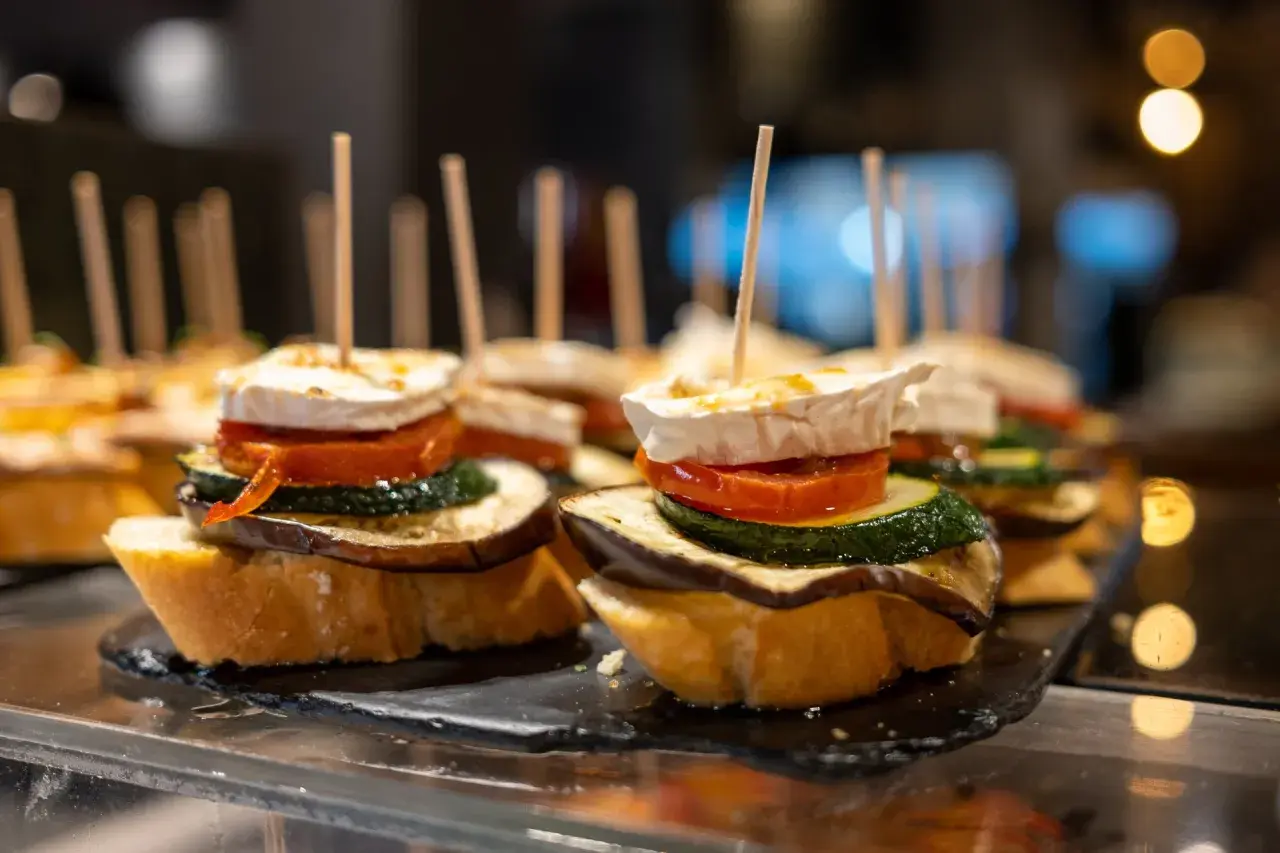
A charcuterie board works best when every bite earns its place: salt against fat, crunch against cream, and enough acidity to keep the whole spread moving. For this article, I am looking at the platter through a Basque lens, where tapas and pintxos turn a simple assortment of cured meats, cheeses, bread, olives, and peppers into something with real rhythm. You will get a practical way to choose ingredients, work out portions, arrange the food, and pair it with drinks that make sense on a UK table.
What matters most before you start assembling the spread
- Build around contrast, not volume: one salty meat, one firm cheese, one briny element, one sweet accent, and one crunchy bite.
- Think like pintxos bars do: small portions, clear flavours, and food that is easy to pick up with a cocktail stick or a slice of bread.
- For light grazing, plan roughly 60-75 g of meat and 60 g of cheese per person; for a main spread, increase both to around 90-120 g.
- In the UK, the easiest win is to use good deli ham, a sheep's milk or Manchego-style cheese, olives, roasted peppers, and a crisp loaf or baguette.
- Keep the board slightly open so the food looks inviting and stays easy to serve.
Why pintxos are a better model for a balanced spread
Tapas can be loose and varied, but pintxos are more disciplined: one strong combination, usually built on bread or secured with a skewer, and designed to be eaten in a few bites. That structure is useful because it stops the platter from becoming a pile of unrelated foods. I like it because it forces you to ask a better question than "What else can I add?" The better question is "What flavour does this bite need next?"
That small shift changes everything. Instead of filling space, you are composing a sequence of salty, creamy, sharp, and fresh bites that keep people going back for one more piece. Once that logic is clear, ingredient choice becomes much easier.

Choose ingredients that bring salt, acid, and crunch
The strongest boards have a clear flavour map. I usually choose one cured meat with depth, one cheese with character, something briny, something sweet, and one or two crisp elements so the platter does not collapse into salt and fat alone.
| Ingredient | Why it earns space | Easy UK source or swap |
|---|---|---|
| Jamon serrano or other air-dried ham | Salty, silky, and thin enough to drape beautifully across the board | Prosciutto or a good British air-dried ham |
| Chorizo or salchichon | Adds paprika, smoke, and a firmer bite than ham alone | Sliced cured chorizo from a good deli counter |
| Idiazabal or Manchego | Nutty, firm, and strong enough to stand up to cured meat | Mature sheep's cheese or mature Manchego |
| Piquillo peppers or roasted red peppers | Sweet acidity and bright colour that wake up the rest of the platter | Jarred roasted red peppers |
| Green olives | Briny, clean, and essential for keeping the food from feeling heavy | Any good-quality green olive |
| Marcona almonds | Buttery crunch with a distinctly Spanish feel | Roasted blanched almonds |
| Quince paste or membrillo | Soft sweetness that bridges cheese and ham without making the board sugary | Quince jelly or paste |
| Anchovies or boquerones | A sharp, saline note that makes everything else taste more alive | High-quality anchovy fillets |
| Bread or baguette slices | Gives structure and turns toppings into proper pintxo-style bites | Country loaf, baguette, or sourdough slices |
With the ingredients set, the next job is arranging them so the food reads as intentional rather than crowded.
How to build the platter so it eats well, not just photographs well
I start with the items that need containers, then build outward. That usually means olives, peppers, or anchovies first, followed by bread, then the meats and cheeses, and finally the smaller accents like almonds and membrillo. The goal is not symmetry; the goal is easy picking and clear flavour at every point on the board.
Read Also: Spanish Potato Salad - The Secret to Perfect Tapas
A simple order that keeps the board tidy
- Place small bowls for wet ingredients first so oils and brine do not spread across the board.
- Add the bread in two or three spots instead of one pile, so people do not crowd a single corner.
- Fold sliced meats into loose ribbons rather than flat stacks; this makes the board look fuller with less food.
- Cut cheese into manageable pieces, not huge blocks, so guests can build a bite without working for it.
- Scatter briny and sweet elements around the edges of the main proteins, because that is where they do the most useful work.
- Leave visible gaps. In food styling, negative space is what keeps the board usable instead of cramped.
I also keep the variety under control. Two cheeses are usually enough, and three is the practical limit unless the board is the whole meal. One hard or semi-hard cheese and one softer option give better contrast than five similarly mild pieces. That balance only works if the portions are realistic, so I always size the board before I think about styling.
How much to serve without wasting food
For light grazing before dinner, I plan modestly. For a meal replacement, I increase the portions and add more bread, vegetables, or a cooked item like tortilla. The most common mistake is buying enough to look impressive for five minutes and then discovering that the board cannot actually feed the table.| Item | Light grazing per person | Main spread per person |
|---|---|---|
| Cured meats | 60-75 g | 90-120 g |
| Cheese | 60 g | 90-120 g |
| Bread or crackers | 40-60 g or 4-6 small pieces | 80-120 g or 6-10 pieces |
| Olives, peppers, pickles | 30-40 g | 50-60 g |
| Nuts | 15-20 g | 20-30 g |
| Sweet element | 10-15 g | 20-30 g |
For six guests at drinks time, that works out at roughly 400-450 g of meat, 400-450 g of cheese, one baguette or a good loaf, 200 g of olives and peppers, and a small bowl of almonds. If you are making it the main food, I would push the meats and cheeses closer to 600-700 g total and add tortilla or another substantial bite. Once the quantities are set, the drink pairing is what gives the spread its shape.
Drinks that match the salt and richness
This style of food shines when the drink has either acidity or fizz. That is why Basque bars often feel so lively: the food is savoury, but the drink keeps the palate clean enough for the next round. If the platter leans heavily on ham, anchovies, and olives, I want the drink to reset the mouth rather than coat it.
- Txakoli if you can find it: bright, light, and naturally suited to salty bites.
- Dry sherry, especially fino or manzanilla: excellent with almonds, olives, and cured fish.
- Rioja: a sensible choice when chorizo and ham are doing most of the work.
- English sparkling wine: the fizz cuts through fat and makes the table feel more celebratory.
- Dry cider: a good fit if you want something crisp and less formal than wine.
- Alcohol-free options: sparkling water with citrus, or a dry tonic with a slice of lemon.
If I had to choose only one rule, it would be this: do not pair a salty, savoury board with a sweet drink unless you deliberately want that contrast. The food already has enough richness. The best drinks keep the palate alert, not dulled. The final step is avoiding the small mistakes that undo all that good work.
The mistakes that make the whole thing feel flat
I see the same problems again and again, and they are easy to fix once you know what to watch for. Most bad boards are not short on food; they are short on contrast and structure.
| Mistake | Why it fails | Better fix |
|---|---|---|
| Too many soft, mild items | Everything tastes similar and the board loses momentum | Use one soft cheese at most, then anchor it with a firmer, sharper option |
| Overcrowding the board | Food warms quickly and flavours blur into one another | Leave visible gaps and use small bowls for wet ingredients |
| No acidic element | The platter feels heavy after just a few bites | Add peppers, pickles, olives, or something lightly pickled |
| Sweetness used too freely | Jam and fruit can flatten the savoury edge if they dominate | Keep sweet accents small and place them beside stronger cheeses |
| Cheese served fridge-cold | Texture tightens and flavour stays muted | Let hard cheeses sit out 30-40 minutes and softer cheeses about 20-25 minutes |
| Only soft bread or only crackers | The board loses textural contrast | Use one good loaf or baguette and slice it late so it stays fresh |
Once these traps are out of the way, the board feels effortless rather than busy.
A Basque-leaning spread that feels intentional at the table
When I want this format to work every time, I build it from a simple formula: one firm sheep's cheese, one cured meat, one briny item, one sweet bridge, one crunch, and one good bread. If the platter is a pre-dinner nibble, keep the portions modest and the flavours sharp; if it is standing in for supper, add tortilla, more bread, and one extra bowl of vegetables or peppers so guests can keep grazing without fatigue.
That is the real advantage of a Basque-inspired spread. It feels generous without being vague, and it gives you enough structure to host confidently without turning the table into an overfilled tray of snacks. Once you learn that balance, the rest is just choosing the right ingredients and letting them speak for themselves.
