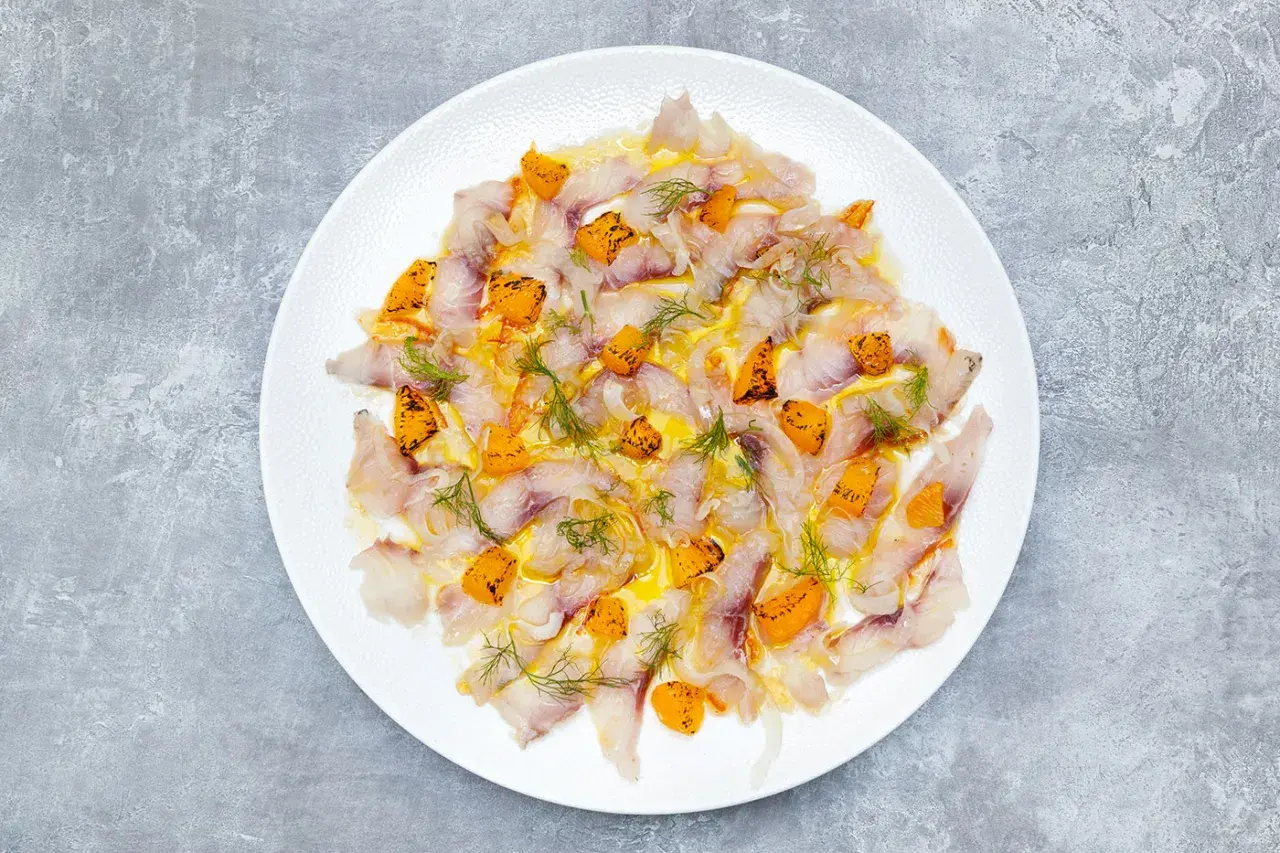
Raw sea bass works because the fish stays clean, delicate, and direct: there is nowhere to hide, so the seasoning has to be precise. In a tapas or pintxos setting, that makes the dish useful in a very specific way, as a small, bright plate that resets the palate rather than weighing it down. Here I look at how to season it, how to plate it, where it fits on a Basque-style menu, and what to watch for when the fish is served raw.
The quick take on a raw fish starter
- Use very fresh, skinless, boneless sea bass and keep the seasoning restrained.
- Slice the fish thinly, usually around 2 to 3 mm, so it eats cleanly and evenly.
- Basque-style accents like olive oil, lemon, fennel, piparras, and herbs work better than heavy sauces.
- For pintxos, think small portions, chilled plates, and a garnish that supports the fish instead of covering it.
- Raw fish safety matters as much as flavour: cold chain, clean handling, and a trustworthy supplier are non-negotiable.
What this dish really is
I think the easiest way to understand this plate is to treat it as raw fish with discipline. It is not about marinating the sea bass until it tastes like something else; it is about keeping the flesh pristine and giving it just enough salt, acid, oil, and texture to make it sing.
That is why this style of dish feels so natural on a tapas menu. It is light enough to start a meal, sharp enough to wake up the appetite, and small enough to sit comfortably among a few other snacks without taking over the table. In practice, I want it to feel like a deliberate pause before the rest of the meal, not a stunt.
The fish itself matters more here than in almost any cooked preparation. A clean aroma, firm flesh, and careful trimming do most of the work. Once you have that, the next question is not how much to add, but how little you can add and still make it interesting.
How I season raw sea bass for a Basque-style plate
For this kind of dish, I keep the seasoning short and specific. A Basque lean is a good fit because the cuisine already knows how to use restraint, saline notes, olive oil, herbs, peppers, and acidity without flattening the main ingredient.
For two starter portions, I usually aim for about 220 to 250 g of skinless sea bass fillet, sliced across the grain into pieces roughly 2 to 3 mm thick. That gives enough surface area for seasoning without turning the dish mushy or awkward to eat.
| Seasoning style | What it tastes like | When I would use it | What can go wrong |
|---|---|---|---|
| Olive oil, lemon zest, flaky salt | Clean, bright, and very fish-led | When the sea bass is excellent and I want the simplest expression | Can feel a little plain if the fish is only average |
| Fennel, dill, cucumber, lemon | Fresh, cool, and lightly aromatic | When I want a northern Spanish or coastal feel | Too much cucumber or dill can push the dish into salad territory |
| Piparras, green olive, chive, olive oil | Saline, gently hot, and distinctly Basque | When I want the plate to feel like it belongs in a pintxos bar | Pickled ingredients can overwhelm if they are not used sparingly |
| Citrus juice, chilli, coriander | Brighter and more assertive | When I want more lift and a slightly bolder starter | Too much acid starts to blur the texture of the fish |
The main rule is simple: use acid like a highlight, not like a bath. I would rather have the fish barely glossed with lemon or citrus juice than fully dressed in it, because the texture stays cleaner and the flavour feels more expensive. That discipline is what keeps the plate in the right register for tapas and pintxos.

Why sea bass crudo works on a Basque bar menu
On a bar counter, the dish has to earn its place fast. It needs to be visually tidy, eat in a few bites, and pair easily with drinks, which is exactly where this kind of raw fish starter earns its keep.
In a Basque context, I would think of it as a modern pintxo rather than a heavy starter. Pintxos are usually small, social, and meant to be eaten alongside a glass of wine, cider, or beer, so the fish should feel energetic rather than formal. If I were serving it on bread, I would use a thin toast or a very crisp base, not a thick slice that buries the fish. In many cases, I would skip the bread altogether and serve it as a chilled plate with a fork.
Presentation matters here, but not in a decorative way. I like the slices slightly overlapping, a few drops of olive oil catching the light, and one or two sharply chosen garnishes: a sliver of fennel, a fine dice of cucumber, a piparra ring, or a few herbs. That is enough. Anything more and the dish stops reading as precise.
The reason this works is balance. The fish gives softness, the oil gives richness, the acid gives lift, and the garnish gives contrast. That is the structure I want before I start comparing it with other raw preparations.
Crudo, ceviche, carpaccio and sashimi are not interchangeable
People often use these terms loosely, but they are not the same thing in the kitchen or on the plate. The difference matters, because if you expect one style and receive another, the whole balance of the dish changes.
| Style | Core idea | Texture | Best for |
|---|---|---|---|
| Crudo | Raw fish dressed very lightly with oil, salt, acid, and garnishes | Soft, fresh, and still very close to the original fish | When you want the seafood to stay front and centre |
| Ceviche | Raw fish or shellfish cured in acid | Firmer and more opaque at the edges | When you want sharper acidity and a more pronounced cure |
| Carpaccio | Very thin slices, usually with a minimalist dressing | Delicate and elegant, often more stripped back | When you want a cleaner, almost austere presentation |
| Sashimi | Knife-cut fish served with very little interference | Pure, firm, and texture-led | When the technique and fish quality are the main story |
The practical takeaway is that acidity changes the experience more than most people realise. Ceviche feels brighter and more assertive because the acid does more work. A crudo-style plate stays calmer and more Mediterranean in tone, which is why I think it suits a Basque-influenced menu so well. That difference leads straight into the question of what to drink and serve alongside it.
What to serve with it in the UK
For a UK audience, I would keep the accompaniments simple and seasonal. The fish should still feel like the centre of the plate, but the supporting elements can steer the dish toward the coast, the garden, or the pintxos bar.
- Txakoli, if you want the most Basque match: light, dry, and a little fizzy.
- Albariño, if you want citrus and stone-fruit lift without oak.
- Dry English sparkling wine, if you want brisk acidity and a clean finish.
- Light cider, if the rest of the menu is casual and snack-driven.
- Fennel, radish, cucumber, and herbs, if you want a fresh vegetable side that does not crowd the fish.
I would avoid heavy oak, sweet sauces, and anything that tastes too smoky or too sweet. A raw fish starter needs a drink with enough structure to refresh the palate, not one that drags the plate into richer territory. If you are building a whole tapas spread, this is the dish I would place before fried food, grilled peppers, or anything with stronger spice.
The safety and sourcing details I never skip
Raw fish is a flavour decision and a handling decision. In the UK, the Food Standards Agency sets expectations for fish intended to be eaten raw or lightly cooked, and I would treat that as a baseline rather than an optional extra. The key point is that freezing is about parasite control, not a substitute for freshness, hygiene, or good sourcing.
When I choose sea bass for this sort of dish, I look for a trusted fishmonger who can tell me when it was landed, how it was handled, and whether it has been frozen appropriately for raw service. The fish should smell clean and sea-like, never sour or aggressively fishy. The flesh should feel firm, not soft or wet in a way that suggests it has started to slip.
At home, I keep the fish cold until the last minute, use a very sharp knife, and work on a chilled plate if possible. Once the fish is sliced, I season and serve quickly. That timing matters because the dish is at its best when it still feels crisp and freshly cut, not when it has been sitting in its own juices for too long.
If any of that sounds uncertain, I would cook the fish instead. There is no virtue in forcing a raw preparation if the supply chain or handling is not right. That caution is what keeps the final plate worth eating, which brings me to the last details that make it feel complete.
The small details that make the plate feel finished
The difference between a decent raw fish plate and a memorable one is usually tiny. I look for three things: a precise cut, a restrained garnish, and a clear idea of where the dish sits on the menu. If those three are in place, the rest tends to fall into line.
I also think restraint is more important here than creativity. One acid, one herb, one textural accent is usually enough. If the plate starts asking for capers, tomatoes, chilli, garlic, and five other ideas at once, the sea bass loses its shape. The best versions feel focused, almost quiet, but not bland.
That is why this dish suits Basque-inspired dining so well. Pintxos culture rewards clarity, quality ingredients, and a sense of occasion without fuss. A chilled plate of well-cut sea bass can do all of that in a very small space, which is exactly what makes it worth keeping on the menu.
