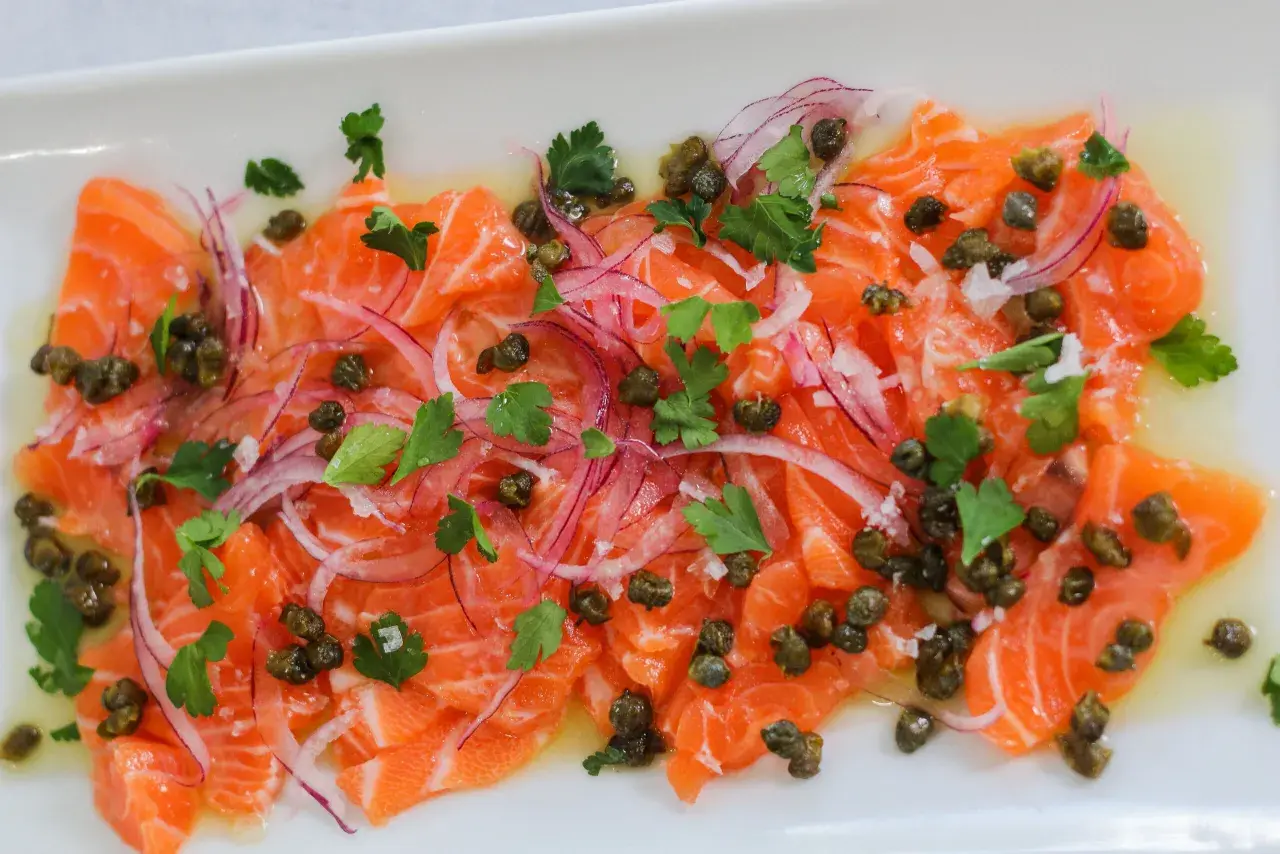
Salmon crudo is one of the cleanest ways to serve raw fish: thin slices of salmon, lightly seasoned, and left to taste fresh rather than masked. In practical terms, the answer to what is salmon crudo is a raw salmon dish built around good fish, careful handling, and very restrained flavouring. That makes it especially useful in tapas and pintxos settings, where one small plate has to do a lot of work.
The practical takeaways on raw salmon in one place
- Salmon crudo is raw salmon served with minimal dressing, usually olive oil, citrus, salt, and herbs.
- It is not the same as sashimi, ceviche, or tartare, even though all four use raw seafood.
- It fits tapas and pintxos culture because it is small, bright, fast to serve, and easy to share.
- The best versions rely on excellent fish, cold service, and very controlled seasoning.
- In the UK, sourcing and hygiene matter as much as flavour, especially with raw seafood.
What salmon crudo actually is
I think of crudo as a technique, not a fixed recipe. The salmon is cut thin or bite-size, kept cold, and dressed with just enough oil, acid, and salt to sharpen the flavour without taking over the fish. The whole point is to keep the salmon at the centre of the plate, with everything else playing a supporting role.
That is why a good plate feels restrained rather than complicated. If the garnish starts acting like the main event, the dish has gone too far. Crudo should taste like fresh salmon first, seasoning second, and texture throughout. That simplicity is also what makes it easy to confuse with other raw seafood dishes, which are not the same thing at all.
How it differs from sashimi, ceviche and tartare
The most common mistake I see is treating every raw fish dish as if it were interchangeable. The fish may be raw in each case, but the technique, flavour, and final texture are different. Once you know the distinction, ordering or serving becomes much easier.
| Style | What happens to the fish | Usual flavour profile | Why it feels different |
|---|---|---|---|
| Crudo | Served raw, usually sliced and lightly dressed | Olive oil, citrus, salt, herbs, sometimes pickles | Built around balance and freshness, not heavy treatment |
| Sashimi | Served raw in precise slices | Very minimal, often soy or wasabi on the side | Focuses on knife work, texture, and the purity of the fish |
| Ceviche | Raw fish is marinated in citrus | Lime or lemon, chilli, onion, coriander | The acid changes the texture and partially “cooks” the surface |
| Tartare | Raw fish is chopped or diced and mixed | Often mustard, capers, herbs, egg yolk, or shallot | More of a seasoned mixture than a sliced presentation |
I use those distinctions because they change both expectation and enjoyment. If someone wants the cleanest possible salmon flavour, crudo or sashimi makes sense. If they want sharper acid and a more transformed texture, ceviche is the better call. That becomes especially useful in tapas and pintxos service, where each bite has to make its point quickly.
Why it fits tapas and pintxos so well
Basque pintxos and Spanish tapas both reward small, direct flavours. Historically, pintxos began as bite-size snacks between drinks and later evolved into a more inventive style of miniature cooking. Salmon crudo fits that rhythm almost perfectly because it is bright, fast, and visually clear.
A small plate of raw salmon can be elegant without being heavy. It can sit on toast, a spoon, a crisp cracker, or a chilled plate and still feel complete. I like it in this context because it brings colour, gloss, and freshness to the counter, and it does not blunt the appetite for the next bite. That matters in a tapas bar, where the meal is meant to move.
The best pintxo-style version is never overloaded. It should feel like a deliberate pause between richer dishes, not a whole speech in one bite. That brings us to the details that separate a good plate from a forgettable one.
What makes a good plate before it reaches the table
The quality of salmon crudo is easy to judge if you know what to look for. I tend to focus on five things:
- Clean smell - the fish should smell fresh and sea-like, never aggressively fishy.
- Even slicing - thin, consistent cuts give the best texture and keep the plate neat.
- Cold service - raw salmon should stay chilled so it feels supple rather than soft.
- Controlled seasoning - one acid, one fat, one herb or pickle is usually enough.
- Good balance - the garnishes should sharpen the fish, not bury it.
I usually want three voices on the plate and no more: salmon, acid, and one supporting note. If I can no longer taste the fish clearly, I would simplify. That is also why safety and sourcing matter so much; there is no cooking step to rescue a poor decision.
How I handle safety and sourcing in the UK
In the UK, I would treat raw salmon as a sourcing decision first and a recipe second. The Food Standards Agency expects fish intended to be eaten raw to be handled under strict controls, and that is exactly the mindset I would copy at home or in a professional kitchen.
- Buy from a fishmonger or supplier who is comfortable saying the fish is suitable for raw service.
- Keep the fish cold from purchase to plate, and use clean knives and boards to avoid cross-contamination.
- Ask whether the fish has been frozen or otherwise managed for parasite control if you are preparing it yourself.
- Check the smell, texture, and appearance before slicing; if anything seems off, do not use it.
- Skip raw salmon for pregnant guests, young children, older adults, or anyone with a weakened immune system unless they have been told otherwise by a health professional.
Freezing helps reduce parasite risk, but it does not make poor hygiene safe, so I never treat it as a free pass. Freshness, cleanliness, and temperature control still decide whether the dish feels composed or risky. Once that is in place, the flavour choices become the fun part.

How I would season it for a Basque-style pintxo
For a Basque-leaning version, I keep the seasoning bright and coastal rather than loud. A few drops of extra-virgin olive oil, lemon zest, flaky salt, and one restrained accent such as dill, fennel, pickled shallot, or a little Espelette chilli are usually enough.- On toast, I would use a thin slice of crisp bread, salmon, dill, and a little pickled onion.
- On a spoon, I would keep it minimal: salmon, lemon oil, cucumber, and chive.
- On a chilled plate, I would add fennel ribbons, olive oil, and a few capers or pickles for contrast.
The rule I keep is simple: if the garnish makes you think of the garnish first, I have gone too far. In a small plate, restraint reads as confidence, and that is exactly the tone I want in a pintxos setting.
When another raw fish style makes more sense
Salmon crudo is not always the best answer, and that is part of what makes it useful. If you want more acid and a marinated finish, ceviche is the better choice. If you want the most direct expression of fish with almost no dressing, sashimi does that job better. If you want something spoonable, mixed, and slightly more textured, tartare usually wins.
My rule is straightforward: salmon crudo should feel like excellent salmon with a few well-chosen accents, not a renovation project. When the fish is cold, clean, and well cut, it becomes an elegant starter that fits a tapas bar, a pintxos counter, or a quiet meal at home without trying too hard.