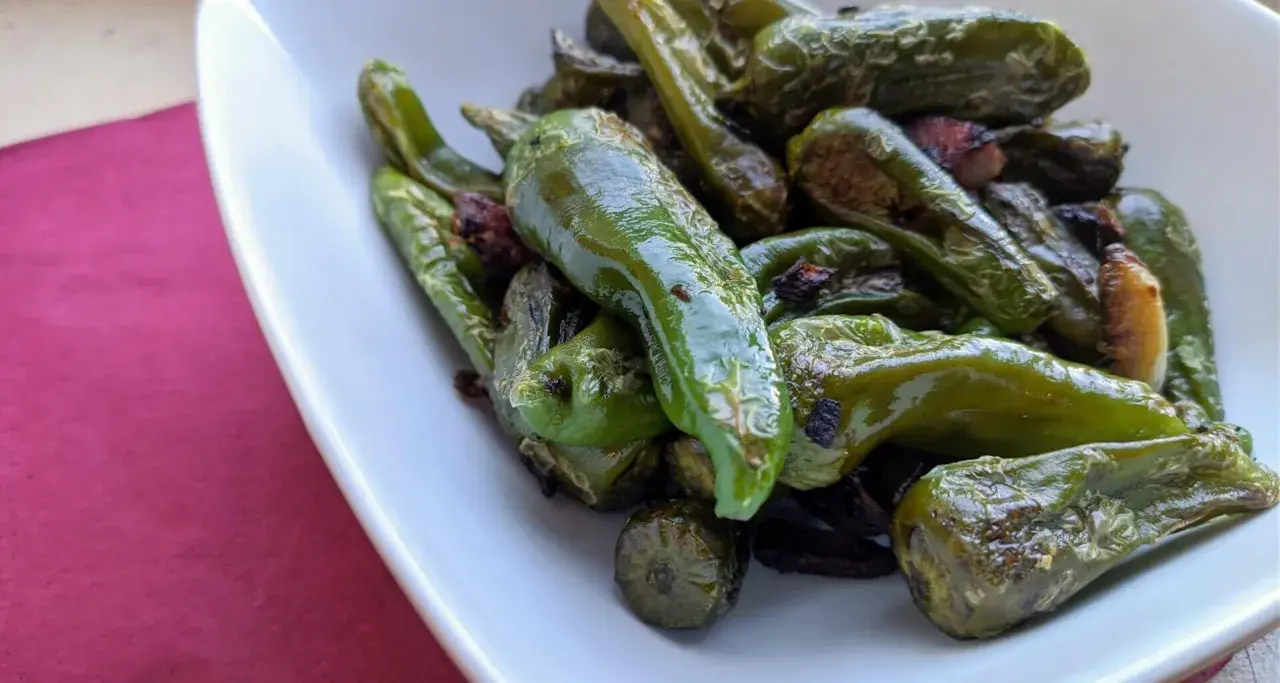
Padrón peppers are at their best when the cooking is fast, hot, and restrained. I’m breaking down how to get the blistered skin, tender bite, and clean salty finish that make the dish work on a tapas or pintxos table, without turning it into a fussy recipe.
You’ll also find the practical details that matter in a UK kitchen: how much oil to use, how long to fry them, what to buy when fresh peppers are scarce, and how to serve them so they stay lively rather than soggy.
The dish depends on heat, timing, and salt, not a long ingredient list
- Use a very hot pan and enough oil to coat the base, not drown the peppers.
- Cook in a single layer for about 2 to 4 minutes, until the skins blister and the peppers soften slightly.
- Finish with flaky sea salt while they are still hot, then serve immediately.
- In the UK, the easiest fresh window is usually late summer into early autumn, with specialist grocers filling the gaps.
- Shishitos are the closest substitute if Padrón peppers are unavailable, but the flavour is a little milder.
Why these peppers work so well with a hot pan
Padrón peppers are built for this kind of cooking. They are small, thin-skinned, and naturally a little sweet, so a short blast of heat gives you the blistered surface you want without collapsing the pepper into mush. The mild heat is part of the appeal too: most peppers stay gentle, but an occasional one brings a sharper kick, which keeps the plate interesting.
That is why I never treat them like a slow braise or a heavy side dish. The flavour comes from a quick sear, not from added sauce or long cooking. In tapas bars, and especially in a pintxos setting where every bite needs to earn its place, that simplicity is exactly the point. Once you understand that, the method becomes very straightforward.

How I fry them for a blistered, tender finish
For a home kitchen, I prefer a heavy skillet over a shallow pool of olive oil. It gives the peppers direct contact with the heat, so the skins blister quickly and the flesh turns glossy rather than greasy. A standard batch starts with about 200 g of peppers and 2 to 3 tablespoons of olive oil.
- Rinse the peppers and dry them thoroughly. If they are wet, they steam instead of blister.
- Heat the olive oil in a cast-iron or heavy frying pan over medium-high to high heat until it shimmers.
- Add the peppers in a single layer. If the pan is crowded, cook in two batches instead of forcing them together.
- Leave them alone for the first 30 to 60 seconds, then toss or turn them occasionally until the skins are blistered and the peppers have softened, usually in about 2 to 4 minutes total.
- Transfer them straight to a plate and finish with flaky sea salt while they are still hot.
If I want a sharper restaurant-style result, I use a slightly hotter pan and move faster; if I want a softer, more relaxed texture, I give them another minute. The balance is the same either way: blistered, tender, and still bright. For comparison, here is how the main cooking approaches differ.
| Method | What it gives you | When I use it |
|---|---|---|
| Skillet frying | Blistered skin, glossy finish, tender bite | The best all-round home method |
| Deep-frying | Crisper exterior and a richer texture | When I need to cook a larger batch quickly |
| Grilling or plancha cooking | Smokier char and a drier finish | Useful outdoors, but less classic for this dish |
The skillet version is the one I come back to most often because it gives the cleanest flavour and the least cleanup. Once the pan work is right, the real question becomes how to serve them while they are still at their best.
How to serve them on a tapas or pintxos table
I like Padrón peppers best when they arrive hot, salted, and almost bare. That is how they feel at home among small plates: not as a side that needs rescuing, but as a sharp, quick bite between richer dishes. In a Basque-style pintxos spread, they work especially well because they bring heat, salt, and freshness without demanding attention.
My usual serving pattern is simple: a warm plate, a generous sprinkle of flaky sea salt, and nothing else unless the rest of the table needs a bridge. If I add anything, I keep it light. A squeeze of lemon can lift a batch that tastes a little flat, but I would not bury the peppers under sauce. They stand up well beside:
- Spanish tortilla
- Gildas
- Anchovy toast
- Jamón or chorizo
- Croquetas
- Crusty bread with olive oil
For drinks, I reach for a crisp dry white, Txakoli if I have it, or a dry cider when I want something a little more relaxed. A cold lager also works better than people expect. The important thing is to keep the drink refreshing, because the peppers are already carrying the flavour. From there, the main threat is not poor pairing but poor technique.
What usually goes wrong and how to fix it
Most disappointing plates of Padrón peppers fail for one of four reasons: too little heat, too many peppers in the pan, wet peppers, or too much time on the stove. All four push the dish toward steaming, and steaming is the enemy here. You want the skins to blister, not soften into something dull.
- The pan is not hot enough. If the oil never gets properly hot, the peppers turn oily before they blister. Wait for the oil to shimmer before adding them.
- The pan is crowded. If the peppers overlap, they trap moisture. Cook smaller batches instead.
- The peppers are damp. Water on the skin causes spitting oil and slower browning. Dry them thoroughly after washing.
- They stay on the heat too long. Past the blister stage, they start to collapse and taste flat. Pull them early; they will finish softening on the plate.
- Salt goes on too late. A prompt finish with flaky salt makes the flavour pop. Waiting until the peppers cool reduces that effect.
If a batch looks too dark, the issue is usually time rather than oil. I would rather serve a slightly underdone pepper that still has a green snap than a wrinkled one that tastes tired. That practical mindset matters even more when you are choosing the peppers in the first place, especially in the UK.
Choosing, storing, and substituting them in the UK
In the UK, I usually look for Padrón peppers from late summer into early autumn, when they are most likely to be fresh and firm. Good peppers should be bright green, glossy, and slightly taut, not soft or dull. If they are unusually large, I am a bit more cautious: larger peppers can be hotter and less delicate, which changes the balance of the dish.
Fresh is always best, but it is not the only workable option. If you find them outside the main season, specialist grocers often carry them, and frozen packs can be useful when you want the flavour without the hunt. I treat substitutes the same way I treat shortcuts in any tapas recipe: acceptable if the result is still lively, but never quite identical.
| Option | Best point | Trade-off |
|---|---|---|
| Fresh Padrón peppers | Best flavour and texture | Seasonal, so availability varies |
| Frozen Padrón peppers | Convenient outside the main season | Slightly softer after frying |
| Shishito peppers | Closest everyday substitute | Usually milder and a little less nutty |
When I have them at home, I keep fresh peppers dry in the fridge and use them within a few days. They are still usable after that, but the texture starts to slide. That is why the final section matters: once the peppers are good, you want to keep them good and not dress them into something else.
Small variations that still respect the dish
I am cautious with variations here, because this is one of those tapas that works by restraint. Still, a few small adjustments make sense when you want to tune the plate for a particular table. A tiny squeeze of lemon can brighten a batch that tastes slightly oily. A side of aioli can help with a richer meal, as long as it stays on the side and does not cover the peppers.
- Use a little extra olive oil at the end if the peppers look dry on the plate.
- Add a very light touch of garlic only if you want the pan to echo the rest of the meal.
- Keep smoked paprika for another dish; it can distract from the pepper’s own flavour.
- Use the grill only when you actually want a smokier note, not as a default substitute.
- Serve them plain when the rest of the table is already rich, salty, or creamy.
The version I prefer most is still the plain one: hot pan, good olive oil, flaky salt, and immediate serving. That is the version that tastes most like a proper bar snack, and it is also the easiest to repeat without losing the character of the dish. The last detail is timing, because these peppers do not improve by waiting.
The small details that keep the peppers bright
If I had to reduce the whole dish to one rule, it would be this: do everything quickly, then stop. Set out the plate before you start cooking. Have the salt ready. Fry in batches if needed. The peppers should come out glossy, slightly collapsed, and still fresh enough to bite cleanly.
I never park them in a warm oven, and I would not hold them under foil either. That turns a lively tapa into a soft one. Serve them the moment they leave the pan, and they will do exactly what they are supposed to do: bring salt, heat, and a little surprise to the table.
