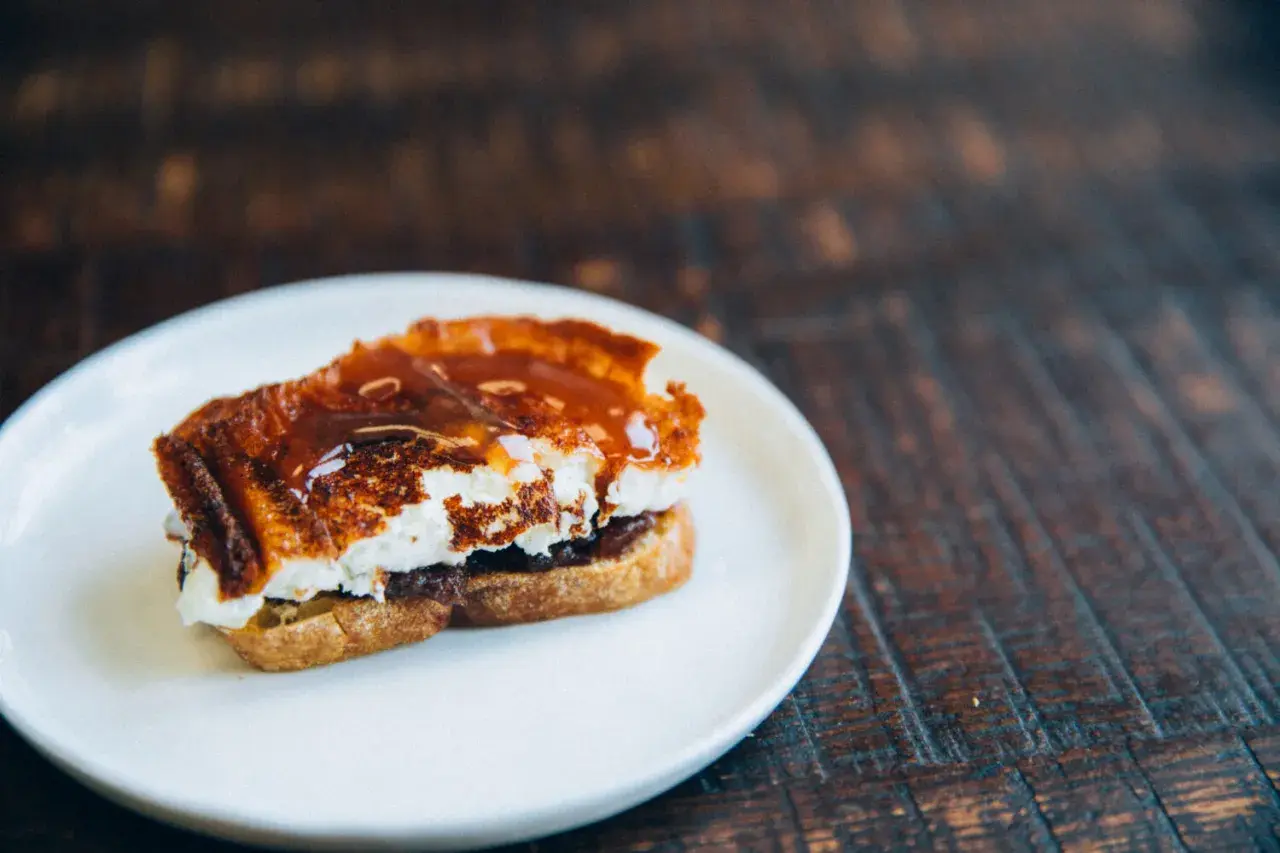
A good goat cheese toast works because it balances crisp bread, creamy tang, and one sharp accent that keeps the bite lively. In a Basque tapas or pintxos setting, that simple idea becomes more than a snack: it becomes a small plate that can carry caramelised onions, roasted peppers, herbs, fruit, or a little honey without losing its shape. Here I focus on how to build it properly, which toppings suit the style, and how to serve it well in a UK kitchen.
The essentials for a crisp, balanced bite
- Use sturdy bread sliced about 1 to 1.5 cm thick, then toast it well before adding anything wet.
- Let the goat cheese soften for 15 to 20 minutes so it spreads cleanly instead of tearing the bread.
- Keep the topping restrained: one main flavour, one accent, and a little seasoning is usually enough.
- Serve it warm or at room temperature, never steaming hot, so the bread stays in control.
- For a pintxo-style spread, plan 2 to 3 pieces per person as a starter or 4 to 6 as a light small-plates meal.
- Dry white wine, English sparkling wine, or a crisp cider all work better than anything too sweet or heavy.
Why this fits the Basque pintxo style
Pintxos are not just mini sandwiches with a more elegant name. In Basque bars, they are part of a social ritual: small bites, good drinks, and a steady move from one counter to the next. The bread matters, but it is there to support the flavour, not dominate it. That is why a dish built on toast and goat cheese feels so at home in this tradition.
I think the best pintxos have three things in common: a solid base, a clear contrast, and a topping that can be eaten in a few bites without falling apart. Goat cheese gives you the creamy base; the contrast can come from onion, pepper, fruit, or herbs; and the bread gives the whole thing structure. Tapas can be broader and looser, but pintxos are usually more precise. That difference matters if you want the plate to feel Basque rather than just vaguely Mediterranean.
Once that structure is in place, the next question is practical: which bread and cheese actually hold up under the topping?
Choosing bread and goat cheese that hold up
Bread that stays crisp
I would use a baguette, sourdough batard, or a proper country loaf before I would use soft sandwich bread. The goal is a slice that stays firm enough to pick up with one hand. Cut it about 1 to 1.5 cm thick, then toast it until the surface is dry and the edges are golden. In a hot oven, that usually takes 6 to 8 minutes; under a grill, it is often closer to 1 to 2 minutes per side.
If the bread bends when you lift it, it is not ready. If it is so hard that it shatters, you have gone too far. I aim for a surface that sounds crisp when tapped but still gives a little at the centre.
Read Also: Salmon Crudo - Not Sashimi! What It Is & Why It's Perfect for Tapas
Cheese that spreads cleanly
Fresh, soft goat cheese is the easiest choice because it spreads smoothly and keeps a bright tang. A firmer, aged goat cheese can work too, but then I would crumble it lightly rather than try to smear it. Let the cheese sit at room temperature for 15 to 20 minutes before assembling; straight from the fridge, it drags the bread and tends to clump.
A good working ratio is about 20 to 30 g of cheese per slice of bread. That is enough to feel generous without turning the slice into a heavy mound. In this kind of dish, restraint is usually the stronger move.

The version I would serve first
If I were making this for guests, I would start with caramelised onion, thyme, and a very small drizzle of honey. It feels Basque without being fussy, and it gives you the contrast that goat cheese needs: sweetness, acidity, and a little herb lift.
This version makes 8 small pintxos and works as a starter for 4 people or a snack for 2 to 3 if you are serving other dishes alongside it.
- 1 small baguette or 4 thick slices of country bread
- 150 g soft goat cheese
- 1 large onion, thinly sliced
- 1 tablespoon olive oil
- 1 teaspoon light brown sugar
- 1 teaspoon sherry vinegar
- Salt and black pepper
- 1 teaspoon thyme leaves
- 1 teaspoon runny honey, optional
- 20 g chopped walnuts, optional
- Heat the olive oil in a pan over medium-low heat and cook the onion slowly for 15 to 20 minutes, stirring often.
- Add the sugar, a pinch of salt, and the sherry vinegar, then cook for another 5 to 10 minutes until the onion is soft, glossy, and lightly caramelised.
- Toast the bread until crisp and golden, then let it cool for 1 minute so it does not melt the cheese too aggressively.
- Spread a thick but even layer of goat cheese over each slice, then top with the onion.
- Finish with thyme, black pepper, and a tiny drizzle of honey. Add walnuts only if you want a bit more crunch.
I like to assemble these as close to serving as possible. Ten minutes earlier is fine; half an hour earlier is not. The bread starts losing its edge, and once that happens the whole thing feels less intentional.
Three topping directions that work on one slice
One reason this kind of toast works so well in a tapas or pintxos spread is that you can move it in several directions without changing the basic formula. I would still keep it restrained. One topping theme is enough; three competing ideas on one slice usually reads as clutter.
| Style | What I would add | Why it works | Best moment to serve it |
|---|---|---|---|
| Classic Basque | Caramelised onion, thyme, black pepper, a touch of sherry vinegar | Sweetness and acidity keep the cheese from feeling flat | As a first pintxo with drinks |
| Briny and savoury | Roasted red pepper, capers, parsley, olive oil | The saltiness sharpens the cheese and makes the bite feel lighter | When the rest of the spread is rich |
| Sweet and nutty | Fig or pear, a thin drizzle of honey, toasted walnut | It plays especially well with mild goat cheese and dry white wine | For a more relaxed aperitif board |
| Herbal and bright | Courgette ribbons, lemon zest, mint or dill, extra virgin olive oil | It keeps the bite fresh when you want something less heavy | In warm weather or with multiple small plates |
My rule is simple: one element should bring sweetness, salt, or sharpness, but not all three at once. That is what keeps the slice readable. When a topping reads clearly from the first bite, it feels like a proper pintxo rather than a crowded brunch plate.
How I would serve it with drinks and other small plates
In the Basque Country, pintxos are often matched with txakoli or cider, and that logic still works beautifully in the UK with easy-to-find drinks. You want something with enough acidity or freshness to cut the richness of the cheese. Heavy reds tend to flatten the bite, while anything too sweet makes the whole thing feel clumsy.
| Drink | Best use | Why I choose it |
|---|---|---|
| Txakoli or a crisp dry white | Classic aperitif serving | The acidity lifts the cheese and keeps the bread from feeling dense |
| English sparkling wine | More polished hosting | The bubbles sharpen the richness and make the bite feel cleaner |
| Dry cider | Casual UK spread | Apple brightness fits the tang of goat cheese very naturally |
| Light pale ale | Mixed crowd or less formal drinks | It is easygoing and does not fight the topping |
For other small plates, I would keep the board in the same family: olives, marinated peppers, tortilla wedges, anchovy skewers, or a simple tomato salad. Two to three pintxos per person is enough if you are serving drinks; four to six works if the toast is the main small plate. If you push much beyond that, the bread stops feeling like a snack and starts feeling like filler, which is exactly what I try to avoid.
The mistakes that make a simple bite feel messy
- Not toasting the bread enough - soft bread sinks as soon as the cheese and toppings go on.
- Using goat cheese straight from the fridge - it tears the bread and spreads unevenly.
- Adding too many wet toppings - tomatoes, olives, and sauce together usually make the slice collapse.
- Skipping acidity or salt - without a sharp note, the cheese can taste heavy and one-dimensional.
- Assembling too early - the bread goes stale on the outside and soggy underneath at the same time.
- Choosing bread that is too soft - a thin slice may look neat, but it will not survive the topping.
If you want the easiest fix for all of that, keep the parts separate until the last minute. Toast the bread, cook the topping, let the cheese soften, and then assemble quickly. That one habit improves the result more than any extra garnish ever will.
A small plate worth repeating
What I like most about this dish is that it is forgiving without being careless. You can keep it very close to a classic Basque pintxo, or you can tilt it toward a more relaxed UK small plate with seasonal produce and a different drink on the side. Either way, the formula stays the same: crisp bread, good goat cheese, and one topping that knows its role.
If I were planning this for a table of six, I would prep everything separately, toast 12 slices of bread, and set the tray out the moment the drinks are poured. That timing matters more than decoration. Handle it that way and the bite stays sharp, balanced, and very easy to finish.
