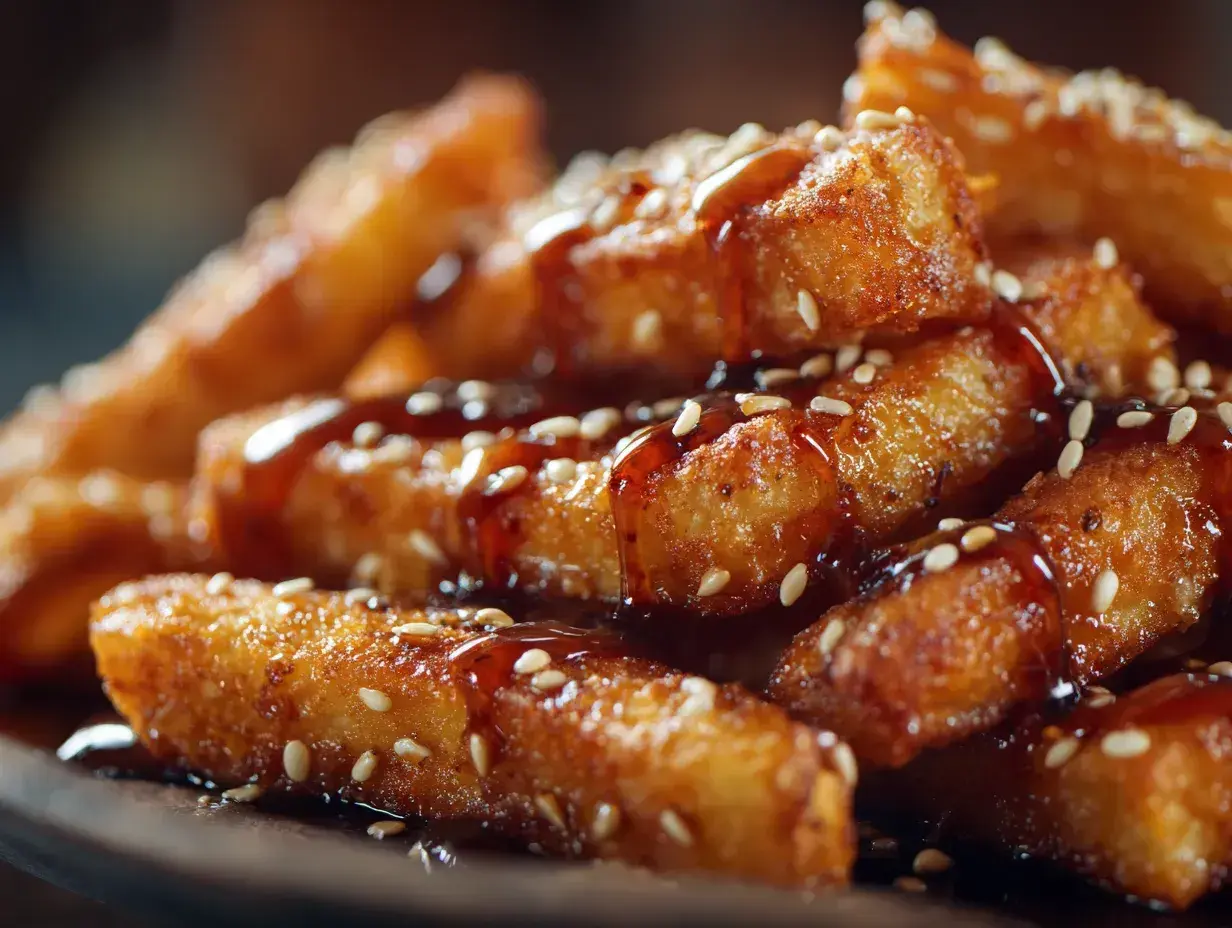
Few Spanish snacks balance sweet and savoury as neatly as the Andalusian tapa known as berenjenas con miel. It is fried aubergine, lightly coated and finished with a glossy drizzle, and the whole point is contrast: crisp edges, a soft centre, and a sweet finish that keeps you going back for another bite. In this article I break down what makes the dish work, how to cook it without greasiness, and how to place it naturally in a tapas or pintxos spread.
What matters before you start cooking
- The most traditional finish is cane molasses, not standard table honey.
- Salt and dry the aubergine first, or the flesh will taste flat and absorb too much oil.
- Light flouring and hot oil, around 170-180C, are what keep the crust crisp.
- The dish is best served immediately, before the coating softens.
- It works as a tapa on its own, and as a pintxo when you shrink it down or serve it on toast.
- Vegetarian by default, and vegan if you use cane molasses instead of bee honey.
What the dish is really about
At first glance, the recipe looks almost too simple to deserve the reputation it has. You cut the aubergine into slices or batons, season it, coat it lightly in flour, fry it until golden, and finish it with a sweet drizzle. The reason it survives on Spanish bar menus is not the ingredient list; it is the contrast. Fried aubergine can be dull if the oil is wrong or the coating is heavy, but when it is crisp and finished properly, it feels rich without being heavy.
In southern Spain, especially around Córdoba and Málaga, the finish is often cane molasses rather than regular honey. That matters because the sweetness is deeper and less perfumed, so the dish stays firmly in savoury territory. I like recipes that do one thing clearly, and this one does exactly that: it turns a humble vegetable into a small plate with real personality.
It also earns its place in tapas culture because it is instantly social. It arrives fast, it is easy to share, and it gives you a complete flavour arc in one bite: salt, crunch, softness, then sweetness. That is the kind of dish I always keep in mind when building a small-plate menu.
The ingredients that do the real work
The dish lives or dies on a few basics, so I keep them honest and do not try to make the list clever. The aubergine should be firm and glossy, the flour should be light enough to dust rather than cake, and the topping should complement the fry rather than drown it.
| Ingredient | What it does | What I use in a UK kitchen |
|---|---|---|
| Aubergine | Provides the soft centre and mild flavour that takes on seasoning | 1 medium-large aubergine, about 350-500 g |
| Salt | Pulls out excess moisture and improves flavour | 1/2 to 1 tsp, then adjust after frying |
| Plain flour or rice flour | Creates the crisp shell | 60-80 g for 1 aubergine |
| Oil for frying | Delivers the golden finish | Enough for shallow frying, usually 300-500 ml depending on the pan |
| Cane molasses or honey | Provides the sweet finish | 1-2 tbsp, added lightly at the end |
The most traditional finish is cane molasses, not the kind of floral bee honey people usually imagine. That distinction matters, because cane molasses gives a darker, deeper sweetness with a slight bitterness that keeps the dish from tasting dessert-like. If you cannot find it, a mild runny honey is acceptable, but I would use less of it than you think.
For readers in the UK, a good Spanish or Mediterranean grocer is the easiest place to look for the right syrup. If you are improvising, pomegranate molasses is sharper and more acidic, while maple syrup pushes the dish too far away from the original flavour. I would treat those as variations, not substitutes that preserve authenticity.
For a lighter texture, rice flour works well, and chickpea flour can add a nuttier edge, though it changes the flavour. If your goal is strict tradition, I would keep the coating plain and let the topping do the talking.
How I fry it so it stays crisp
The biggest mistake is treating aubergine like any other vegetable. It is spongy, so if you move slowly or fry at a weak temperature, it drinks oil and turns soft before it turns golden. My method is straightforward and works consistently.
- Slice the aubergine into 5-7 mm rounds or short batons.
- Salt it for 10-15 minutes, then pat it dry with kitchen paper.
- Coat it lightly in flour and shake off the excess.
- Fry in batches at 170-180C until the coating is pale gold and crisp, usually 2-3 minutes per side depending on the cut.
- Drain on a rack or paper and season again while hot.
- Finish with a small drizzle of cane molasses or honey just before serving.
I prefer a rack to a flat plate because steam has nowhere to hide. That tiny detail matters more than people expect. If the slices sit in their own heat, the crust softens before they reach the table.
You can bake or air-fry a version if you want less oil, and it will still be tasty, but I would treat that as a weekday adaptation rather than the restaurant version. The classic texture depends on direct frying and a quick finish.
The other small decision that helps is batch size. I never crowd the pan. Once too many slices go in, the oil temperature drops, the coating drinks fat, and the dish stops tasting bright. That is one of those kitchen habits that feels minor until you compare the results side by side.
Where it sits in tapas and pintxos culture
This is a useful dish to understand if you care about Spanish small plates, because it shows how one recipe can belong comfortably to more than one setting. On a tapas table, it is a self-contained plate. In a pintxos context, it needs a little adaptation, usually a smaller portion or a base of bread, so it can be eaten in a couple of bites while standing at the bar.| Format | How the dish appears | Why it works there |
|---|---|---|
| Tapas | A small plate of fried aubergine finished with sweet drizzle | Easy to share, no extra assembly required |
| Pintxos | A single slice or baton on toast, sometimes with a toothpick | More structured, easier to eat standing up |
| Modern small plates | Served in a shallow dish with careful plating | Good for restaurant menus and mixed tasting boards |
That distinction is worth keeping in mind if you are building a Basque-style spread in the UK. A proper pintxo usually feels more deliberate, almost engineered for the hand, while a tapa is looser and more relaxed. This aubergine dish lands naturally on the tapas side, but I have served a pintxo-style version on toasted sourdough with a single crisp slice, and it works because the flavour logic is the same: salt, crunch, sweetness, balance.
If you want the plate to feel more rooted in a northern Spanish bar, keep the garnish minimal. A toothpick, a neat toast base, or a tiny dish is enough. Piling on garnish usually weakens the idea.
What I would serve with it
The sweetness makes pairings more important than people think. If you serve the dish beside another rich or sweet item, the whole table can start to feel cloying. I like to steer it toward drinks and sides that are dry, saline, or sharply acidic.
| Pairing | Why it works |
|---|---|
| Dry fino or manzanilla | Clears the palate and keeps the sweetness in check |
| Txakoli or a crisp dry white | Brings acidity and a light, refreshing finish |
| Dry cider | Feels especially good in a UK setting and handles fried food well |
| Light lager or pale ale | Useful when you want an easier pub-style pairing |
| Olives, anchovies, or grilled peppers | Builds contrast on the table and keeps the plate from feeling one-note |
When I am composing a wider tapas spread, I would place this next to something salty rather than creamy. Gildas, boquerones, tortilla, or simply good olives all make sense. The point is not to compete with the sweetness; the point is to frame it so the aubergine still tastes bright.
For readers in the UK, I would also say this dish works surprisingly well with a dry sparkling wine by the glass if you are not in the mood for fortified wine. Keep the drink lean and the food will do the rest.
The mistakes that make it heavy
I see the same problems repeat whenever this dish gets made at home, and almost all of them are easy to fix.
- Cutting the aubergine too thick, which leaves the centre dense while the outside overcooks.
- Skipping the salting step, which makes the slices taste flatter and absorb more oil.
- Using too much flour, which creates a chalky coating instead of a thin crust.
- Frying in oil that is not hot enough, so the coating goes limp before it browns.
- Adding the sweet finish too early, which softens the crust before the plate reaches the table.
- Using a strong, perfumed honey when a lighter or darker syrup would give a cleaner result.
If I had to choose one fix that changes everything, it would be heat control. Most home cooks underheat the oil, then wonder why the food feels greasy. A properly hot pan gives you less absorption, a cleaner flavour, and a finish that reads as bar food rather than fried leftovers.
There is also a compromise worth naming: if you want a lighter dish, you can reduce the oil, but you cannot remove it entirely and still expect the same texture. This is one of those recipes where the method is part of the identity, not just a delivery system.
The version I would put on a small-plate menu
If I were serving this at home for friends, or in a simple menu built around Spanish small plates, I would keep the format tight: one aubergine, a light flour dusting, a proper fry, and a restrained finish. I would serve it on warm plates, because warm plates protect texture for just long enough to matter.
I would also keep the portion modest. The dish is at its best when it feels like a sharp, memorable bite rather than a heavy vegetable side. Two small servings, shared with salty dishes and a dry drink, usually feel more authentic than one oversized plate.
For me, that is the whole appeal: a simple Andalusian classic that travels well, fits a tapas counter or a pintxos board, and still feels special as long as you respect the contrast between crisp, savoury aubergine and the sweet finish on top.
