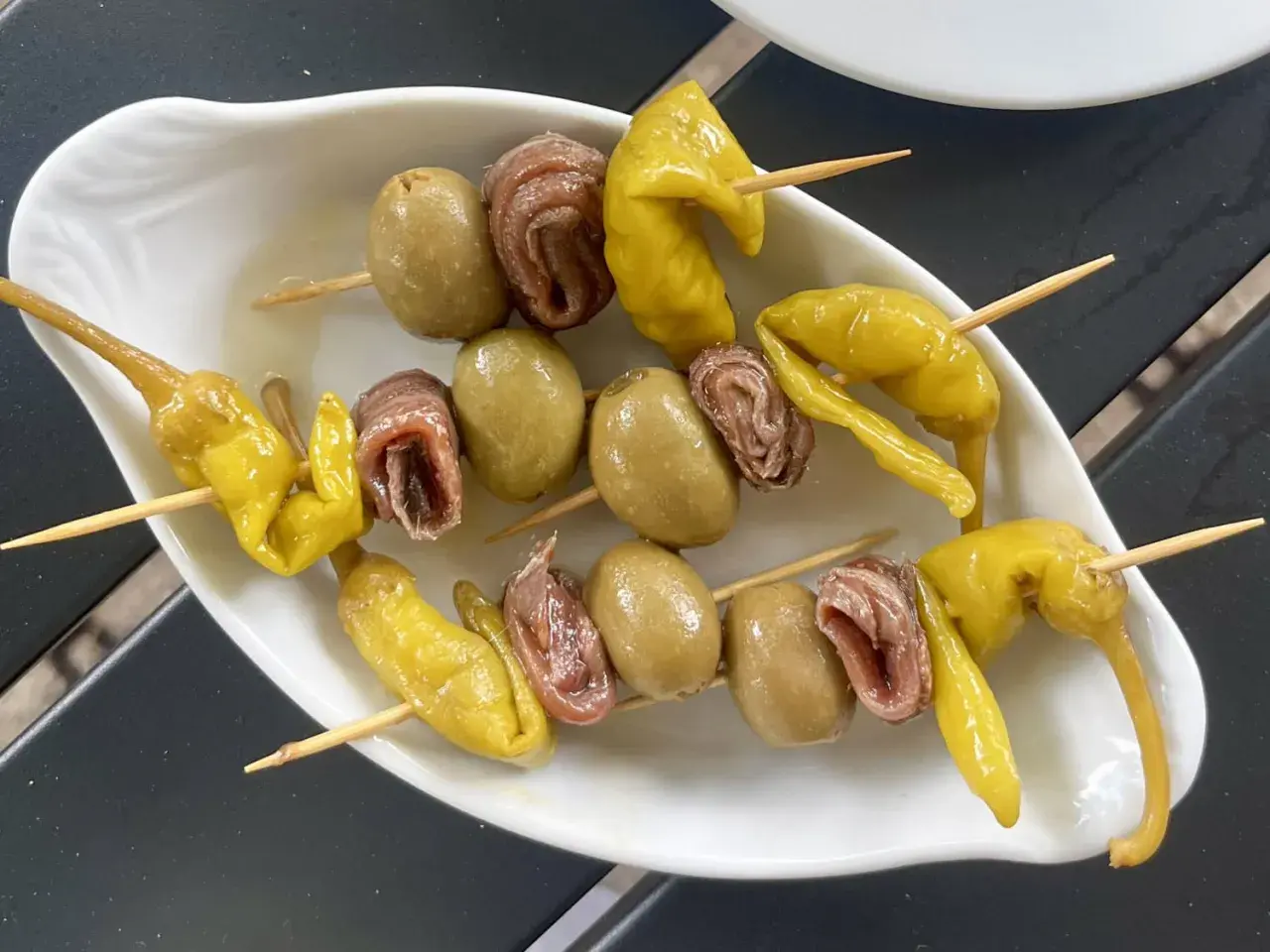
For me, gilda food is less a recipe than a lesson in balance: briny anchovy, sharp pickled pepper and a mellow olive, all doing their job on one skewer. This guide explains what the Basque pintxo is, how it differs from tapas, how to build it properly at home, and what to drink with it. I also cover the small details that matter most, because with a snack this simple, quality and proportion do the heavy lifting.
The essentials at a glance
- A gilda is a classic Basque pintxo made from an olive, an anchovy and a pickled green pepper on a skewer.
- It is meant to be eaten in one bite, so the flavours land together instead of one after another.
- The classic version works because it combines salt, acidity, fat and a little heat.
- Pintxos are usually more bite-sized and bar-led than many tapas dishes, although the two traditions often overlap.
- In the UK, the hardest part is not the technique; it is finding good anchovies and the right pepper.
- It pairs naturally with txakoli, dry cider, a crisp beer or a dry white wine.
What a gilda is and why it matters in Basque bars
The gilda is one of those dishes that looks almost too simple to deserve its reputation, and then you taste it and understand why it stayed. San Sebastián Tourism describes it as the city’s best-known pintxo, and that feels right to me: it is compact, direct and built around a very clear flavour idea. The name is usually linked to Rita Hayworth’s character in the 1946 film Gilda, which suits the snack surprisingly well, because the bite has the same sort of sharp, stylish confidence.
What makes it important is not only its history but its logic. A good gilda is salty, bright, oily and slightly spicy, so it wakes the palate rather than filling it up. That is why it has become such a reference point in Basque bar culture: if the simplest skewer works, the rest of the pintxo counter has to be worth taking seriously too. From there, it is natural to ask how it differs from tapas in the broader Spanish sense.
Tapas vs pintxos and where this bite fits
People often use “tapas” as a catch-all, but in the Basque Country the rhythm is a little different. Tapas are usually shared small plates, while pintxos are more often individual bites, commonly served on the bar and held together with a skewer or toothpick. That distinction is not absolute, but it helps explain why the gilda feels so concentrated: it is designed as a single, deliberate mouthful rather than a dish you pick at over time.
| Point | Tapas | Pintxos | Where the gilda fits |
|---|---|---|---|
| Serving style | Shared small plate | Usually one bite, often on a skewer | Built as a single bite on a stick |
| Portion size | Can range from tiny to fairly generous | Usually compact and bar-friendly | Very small and intentionally focused |
| Eating rhythm | Often ordered as part of a longer meal | Commonly eaten while moving from bar to bar | Best enjoyed quickly, before the ingredients lose their snap |
| Social setting | Table-led, informal sharing | Standing at the bar is common | Fits the standing, quick-stop pintxo routine perfectly |
| Practical takeaway | More flexible and broad | More precise and bar-specific | Think of it as the Basque shorthand for flavour balance |
In San Sebastián’s own 2026 gastronomy guide, pintxo-going is described as a social act, with the usual companions being a small beer, txakoli or Basque cider. That is the right frame for a gilda as well: it is not trying to be a main course, and it is not trying to be decorative. It is a tightly edited bite, which is exactly why the ingredient choices matter so much.
The ingredients that define the classic version
The classic gilda is built from three things only: a green olive, a pickled pepper and anchovy. Remove one and you no longer have the same experience, because the point is the contrast between saline, acidic and oily notes. I would describe it as a dish with no hiding places: if any part is dull, soft, sweet or low quality, the whole bite gets flatter.
| Ingredient | What to look for | What to avoid | Why it matters |
|---|---|---|---|
| Olive | Firm, green, pitted olives such as Manzanilla | Very soft or heavily flavoured olives | Gives the skewer body and a buttery finish |
| Anchovy | Oil-packed fillets with a clean, savoury aroma | Dry, overly salty or mushy anchovies | Brings umami and the deep salt note that defines the bite |
| Pepper | Pickled guindilla or piparra peppers | Sweet roasted peppers if you want the classic profile | Supplies acidity and a gentle kick rather than sweetness |
If you are shopping in the UK, the easiest substitution is usually a mild pickled pepperoncini when guindillas are unavailable, but I would treat that as a fallback rather than the ideal. The closer you stay to the original shape of the flavour, the better the result. Once you know what each piece is doing, building the skewer becomes straightforward.

How I would build one at home
I keep the method almost embarrassingly simple, because that is how the best versions work. For 8 skewers, I would use 8 pitted olives, 8 anchovy fillets and 4 pickled peppers split in half, plus 8 cocktail sticks or small skewers. The whole job takes about 10 minutes if the ingredients are ready.
- Drain the olives, anchovies and peppers well so the skewer does not turn greasy or slippery.
- If the peppers are long, cut them into pieces that will sit neatly on the stick.
- Thread the ingredients so each skewer has a good balance of olive, pepper and anchovy. The exact order can vary slightly from bar to bar, but the practical aim is the same: every bite should contain all three flavours.
- Press the anchovy gently into place rather than crushing it. Fold it loosely if needed so it sits neatly.
- Arrange the finished skewers on a small plate and finish with a tiny drizzle of good olive oil only if the ingredients need it.
I would serve them right away, or at most after a short chill if I had made them a little ahead. The snack is at its best when the pepper is still bright, the olive still firm and the anchovy still clean on the palate. That brings us to the drink side of the equation, which matters more here than people sometimes expect.
What to drink with it
The best pairings for a gilda are sharp, dry and refreshing. That is why txakoli, Basque cider and small beers keep showing up in pintxo bars: they cut through the salt and oil instead of fighting them. A dry sparkling wine works for the same reason, and so does a crisp white if you want something easy to source in the UK.
| Drink | Why it works | Best use |
|---|---|---|
| Txakoli | Light, slightly acidic and built for pintxos | Closest to the Basque bar experience |
| Basque cider | Fresh and tart, with enough grip for anchovy | Great if you want a more rustic pairing |
| Dry sparkling wine | Clears the palate between bites | Useful for aperitif service or gatherings |
| Light lager or pilsner | Cold, clean and easy against the salt | Practical for casual UK drinks tables |
| Dry white wine | Lets the pepper and anchovy stay in focus | Best when you want a quieter pairing |
If I were serving this at home in the UK, I would avoid anything sweet, heavily oaked or too aromatic. The gilda is already doing a lot in a small space, so the drink should clear the way, not compete. Once that is in place, the main thing left is avoiding the mistakes that turn a great bite into an average one.
Where the classic goes wrong and the modern versions begin
Most weak gildas fail for the same reason: someone treated them like a garnish instead of a finished bite. The problem is not complexity; it is laziness with ingredients and balance. Here are the mistakes I watch for most often.
- Using sweet peppers instead of a proper pickled pepper. Sweetness blunts the briny edge that makes the skewer work.
- Choosing soft olives that collapse in the mouth. The olive should hold its shape and give the bite some structure.
- Buying poor anchovies just to keep the cost down. With only three ingredients, anchovy quality is impossible to hide.
- Drowning the skewer in oil. A little sheen is fine; a puddle changes the experience from crisp to heavy.
- Assembling too far in advance without thinking about texture. A few hours is workable, but the best versions are still fresh and firm.
There are also modern variations, and some are genuinely good. A little pickled onion, a strip of smoked fish or a small piece of cured tuna can work if the bar wants to stretch the idea without losing the salty-acid balance. Once bread gets involved, though, you are usually in a different pintxo family, and I think that distinction is worth keeping clear rather than flattening everything into one generic “Spanish snack” category. That is also why the final details matter so much when you serve it.
The details that make the whole thing feel Basque
What makes the gilda feel authentic is not only the ingredients but the way it is eaten. Keep the portions small, let people take one or two at a time, and do not turn it into a heavy starter that sits on the table untouched. In a proper pintxo rhythm, this is a bite you choose, eat and then move on from, which keeps the whole experience lively.
For a UK table, I would serve it on a small plate or wooden board, with a dry drink nearby and no extra garnish crowding the skewer. If you are hosting, make them just before guests arrive and keep the rest of the spread light so the gilda still reads as the sharp, confident snack it is. That restraint is the real lesson here: when the product is right, a three-ingredient pintxo can carry more character than far more elaborate food.
If you want to cook or serve more Basque food with the same clarity, start with this idea and let it guide the rest of the menu: choose a few good ingredients, keep the format simple and protect the balance instead of decorating it away.
