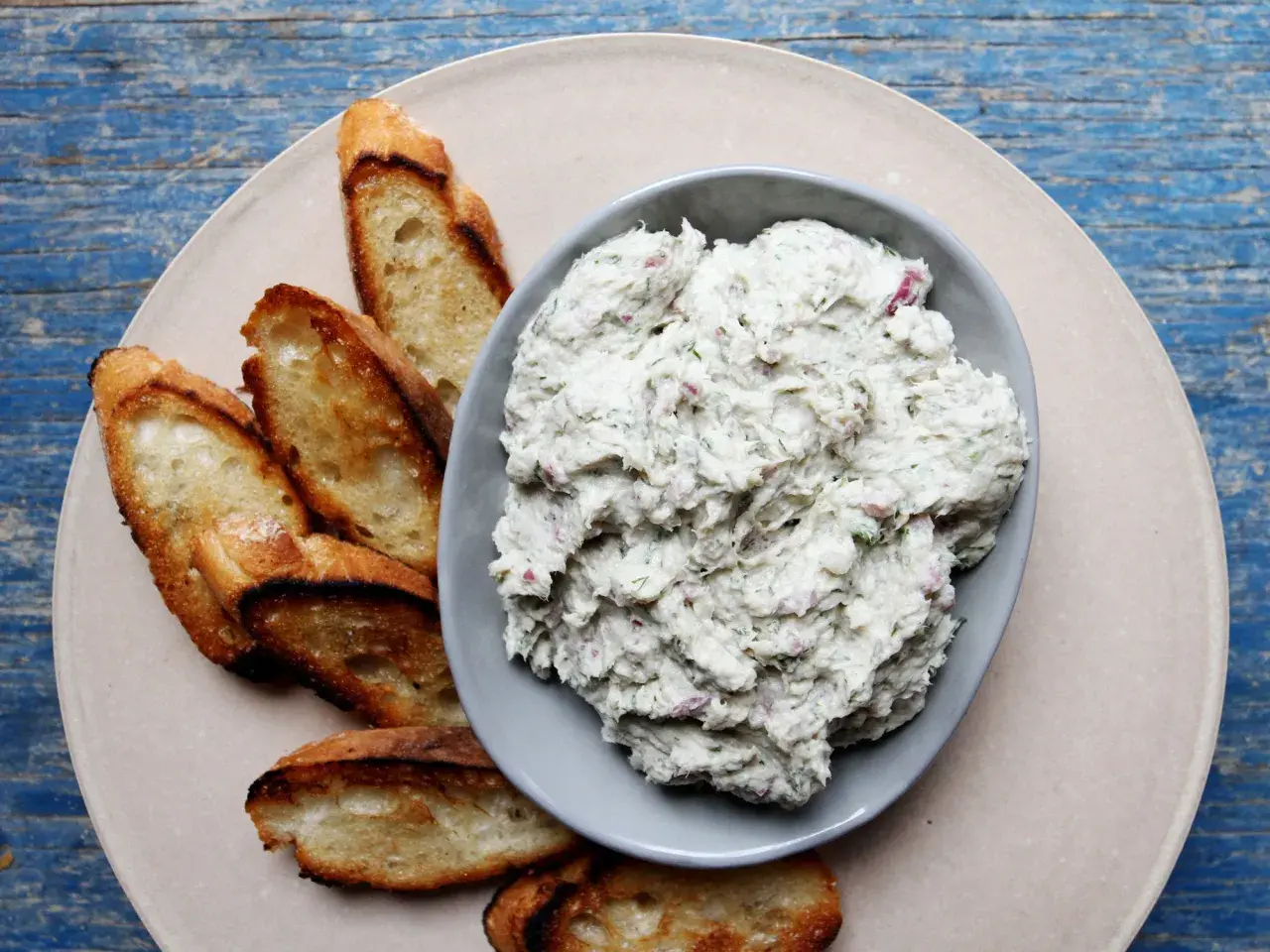
Bluefish pate sits in the sweet spot between rustic and elegant: rich fish, bright acidity, and just enough creaminess to spread cleanly over toast. In a Basque-style tapas or pintxos setting, it works because every bite needs contrast, not complexity. I’m going to break down what the spread should taste like, how to serve it properly, and what to use in the UK when bluefish is harder to source.
A good fish spread needs smoke, acid and a light hand with the cream
- For pintxos, the spread should be bold enough to stand up to bread, pickles and herbs.
- Smoke or gentle roasting gives the fish backbone; lemon or vinegar keeps it from tasting flat.
- A creamy base should soften the fish, not bury it, so start small and adjust.
- In the UK, smoked mackerel is the most practical stand-in if bluefish is unavailable.
- Serve it slightly warmed from the fridge, but not icy cold, for the best texture and flavour.
Why bluefish pate works so well in pintxos
Bluefish is naturally oily and assertive, which is exactly why it behaves well in a spread. When I turn it into a pâté, I am not trying to make it delicate; I am trying to give that richness a cleaner shape. That is the same logic behind many good pintxos: one strong flavour, one bright note, and a base that keeps everything neat.
Tapas and pintxos are not identical, but the overlap matters here. Pintxos are usually smaller, more pointed bites, often built on bread or held with a skewer, so the topping has to earn its place. A soft fish spread does that job best when it is concentrated, well seasoned, and paired with something crisp or briny.
For me, the real appeal is balance. A bowl of bluefish pâté can feel rich on its own, but on toasted bread with pickled onion or a few chopped herbs, it becomes a proper bar snack rather than just a dip. That balance is what makes the next step so important: the flavour formula.
How to balance smoke, cream and acidity
The fastest way to ruin a fish spread is to treat it like plain cream cheese with seafood mixed in. I prefer to think in ratios. For 200 g of flaked fish, I usually start with 80-100 g of cream cheese or labneh, 1 tablespoon of lemon juice, 1 tablespoon of capers, and 1 to 2 tablespoons of very finely chopped shallot. Labneh, for anyone who has not used it often, is thick strained yogurt with a clean tang that works like a lighter cousin of cream cheese.
Smoke should give the spread depth, not a burnt edge. If you are smoking the fish yourself, keep the wood gentle and the cook time short enough that the flesh stays moist. If the fish is already smoked when you buy it, I would keep extra smoky ingredients, such as smoked paprika, on a short leash. Too much smoke quickly turns what should be a bright appetizer into something heavy and muddy.
Use enough acid to lift the fish
Lemon juice is the simplest fix, but it is not the only one. A teaspoon of white wine vinegar, a splash of pickle brine, or a few chopped capers can all sharpen the flavour. The point is not to make the spread sour. The point is to give the fat in the fish somewhere to go so the finish feels clean.
Read Also: Berenjenas con Miel - Perfect Crispy Fried Aubergine
Keep the texture slightly rough
I like a spread that still shows flakes of fish. If you blitz everything until it is perfectly smooth, the result can taste oddly generic, like fish-flavoured spreadable cheese. Hand-mixing gives you a better texture and a more honest flavour. That small bit of irregularity matters when the dish is meant to sit on a pintxo board rather than disappear into a sandwich.
Once the base is right, the question becomes how to plate it so it reads as Basque-inspired rather than simply homemade.
How to serve it as pintxos without making it feel heavy
The best serving format is a slice of well-toasted bread, not soft bread and not an oversized cracker. Bread gives the spread structure and lets the briny garnish stay in place. I usually cut baguette or sourdough into pieces about 1 cm thick, then toast them until the surface is dry and the edges are just turning golden.
For each piece, I use 1 heaped tablespoon of the spread at most. That sounds modest, but pintxos are supposed to be bite-sized. Add too much and you lose the neat contrast that makes the dish feel intentional. If I am making a larger board, I count on a 250 g bowl of spread to serve 4 people as a starter or 6 to 8 people as part of a wider selection.
- Top with chopped dill, chives or parsley for freshness.
- Add sliced pickled onion, cornichons or finely chopped gherkins for brightness.
- Use green olives or a strip of pickled pepper to echo classic Basque bar flavours.
- Serve with crisp cucumber or radish if you want a cleaner, lighter board.
- Let the spread sit out for 15 to 20 minutes before serving so the texture loosens slightly.
For drinks, I would reach first for a very cold, dry white with sharp acidity. Txakoli is the obvious Basque choice, but in the UK a brisk English sparkling wine or a mineral white with low oak also works well. The main idea is simple: the drink should cut through the fish, not compete with it. Once the board has that rhythm, the only remaining challenge is sourcing the right fish in the UK.
What to use in the UK when bluefish is hard to source
In the UK, I would not plan this dish around finding bluefish in an ordinary supermarket. I would plan around flavour first, then choose the closest fish available from a good fishmonger or deli counter. The goal is an oily, characterful fish that can survive cream and acid without disappearing.
| Substitute | What it brings | Best use |
|---|---|---|
| Smoked mackerel | Rich, oily, familiar, and close in intensity | The best all-round stand-in for a punchy pintxo spread |
| Smoked herring | Brinier and slightly firmer, with a deeper sea flavour | Good if you want a more savoury, old-school finish |
| Smoked trout | Lighter, cleaner, and a little more delicate | Useful when you want a softer spread that still feels elegant |
| Smoked salmon | Silky and widely available, but less forceful | Works if you want a gentler version, though it is less Basque in character |
If I were building this for a UK kitchen, smoked mackerel would be my first choice. It has enough oil, salt and personality to behave like the original idea, and it does not need much coaxing. If you choose a milder fish, I would cut back on the cream base a little and add more lemon, capers or pickled garnish so the spread still has a clear edge.
What I would not reach for is a very lean white fish. Cod or haddock can be good in other dishes, but they do not naturally give you the depth this kind of spread needs. The dish starts to feel thin unless you add so much extra seasoning that it loses its shape. That is the trade-off worth keeping in mind before you mix anything.
Mistakes that flatten the flavour
The most common mistakes are small ones, which is why they are easy to miss. They do not make the dish inedible. They just make it less vivid than it should be.
- Over-blending - a completely smooth paste can taste one-dimensional, so stop before the texture turns gluey.
- Too much dairy - once cream cheese takes over, the fish becomes background noise.
- Not enough acid - without lemon or vinegar, the spread feels heavy and flat.
- Serving it too cold - fridge-cold pâté tastes muted, so give it 15 to 20 minutes before serving.
- Overloading the garnish - too many competing toppings blur the flavour instead of sharpening it.
I also think people sometimes forget the bread. If the base is soft, stale or too thick, the bite falls apart. Toasted bread gives the spread the right stage, and that matters more than most people expect. Once those details are controlled, the dish starts to feel like a deliberate pintxo rather than a leftover fish dip.
A Basque-style board that makes the spread feel at home
When I want this to feel coherent, I build the rest of the board around contrast: one salty element, one acidic element, one crunchy element and one drink that cleans the palate. That is enough. You do not need a dozen components to make the spread interesting.
- A bowl of the fish spread on toasted bread rounds
- Green olives or a few pickled peppers
- Radishes, cucumber or celery for crunch
- A second pintxo with anchovy, olive or tomato for contrast
- A chilled dry white or a sharp sparkling wine
That combination gives the spread proper context: not as a generic dip, but as part of a small, confident Basque-style aperitif. If you keep the flavours bright, the texture slightly rough and the portions small, the dish does exactly what good pintxos should do - it feels simple, but it never feels lazy.
