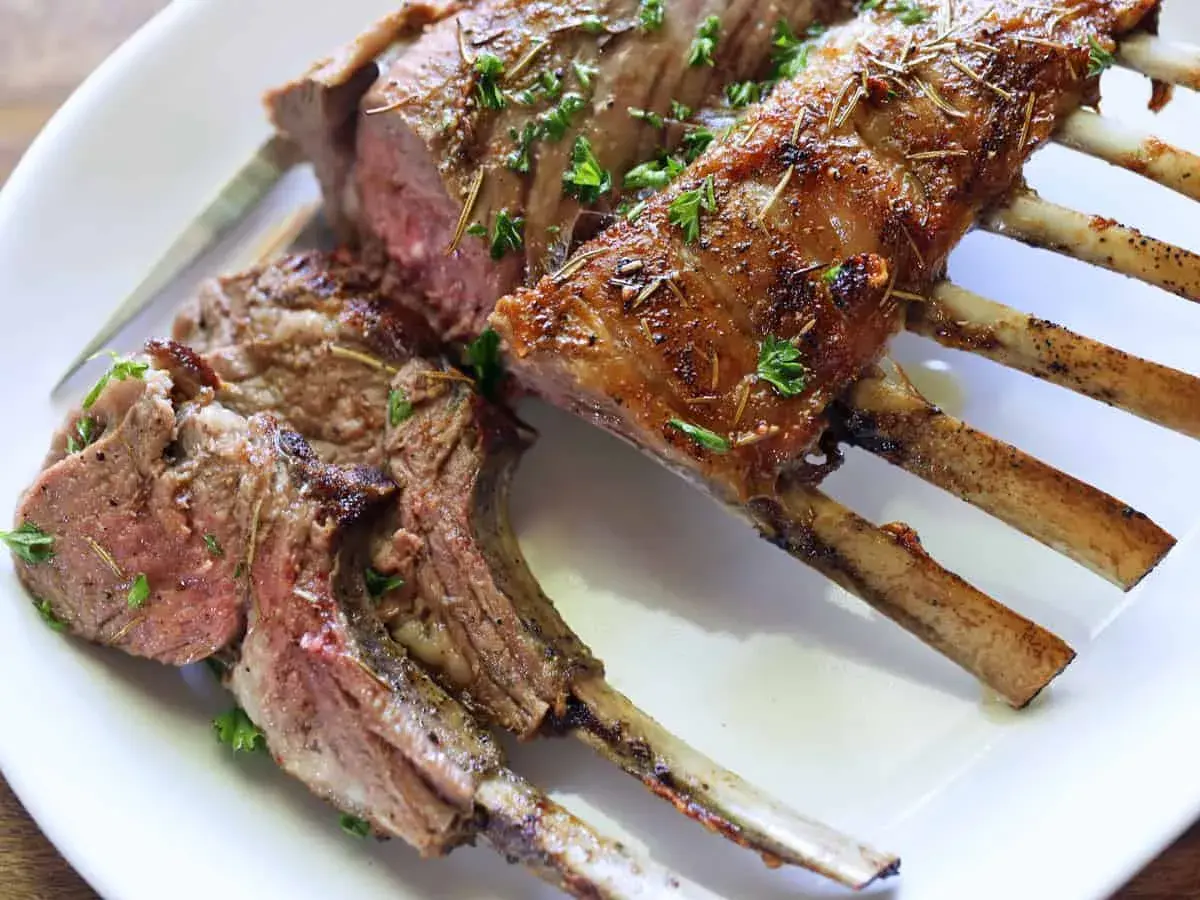
A good roast lamb recipe should give you a browned, fragrant crust and a centre that stays juicy, not grey and tight. In this guide, I cover the cut to buy, the seasoning that actually works, the oven settings I trust in a UK kitchen, and the carving and serving steps that make the whole dish feel composed rather than rushed. I also add a Basque-leaning finish for anyone who wants the plate to feel a little brighter without losing the comfort of a Sunday roast.
The fastest route to a juicy roast is simple seasoning, a hot start, and proper resting
- For an all-purpose roast, choose a leg of lamb; for a softer, shreddable finish, choose shoulder.
- Salt, garlic, rosemary, lemon zest, olive oil, and black pepper are enough for most roasts.
- For a 2kg leg, a 20-minute blast at 220°C/200°C fan, then 1 hour to 1 hour 20 minutes at 190°C/170°C fan, is a reliable UK benchmark.
- Use a thermometer if you can: 52-54°C gives medium-rare, 57°C gives medium, and 70°C held for 2 minutes is the fully cooked target.
- Rest the lamb before carving, then serve with gravy, mint sauce, and something sharp on the side.

Choose the cut that matches the meal you want
The cut decides almost everything: flavour, timing, carving, and how forgiving the roast will be. For a classic Sunday centrepiece, I reach for a leg of lamb because it gives you clean slices and a proper roast appearance; for a more relaxed meal, shoulder is the better choice because it turns soft and shreddable after a long cook. A 2kg to 2.5kg leg is usually enough for 4 to 6 people, which is the sweet spot for a family table.
| Cut | Best for | What to expect | My take |
|---|---|---|---|
| Leg of lamb | Sunday roast, clean slices, serving 4 to 6 | Juicy, sliceable, classic | The safest all-round choice if you want a traditional roast dinner. |
| Shoulder | Long, slow roasting and pulled meat | Richer, more forgiving, deeply tender | Best when you want the meat to fall apart rather than carve neatly. |
| Rack | Smaller dinners and a more elegant plate | Delicate and fast-cooking | Lovely, but it is a different kind of roast and needs tighter timing. |
If I had to make one recommendation for most home cooks, it would be a leg. Shoulder is excellent, but it belongs to a slower, more indulgent style of cooking, and I would not use the same oven plan for both. Once you know the cut, the seasoning becomes much easier to keep balanced.
Season it with restraint and let the lamb do the work
Lamb can take bold flavours, but I think it tastes best when the seasoning supports the meat instead of smothering it. A sharp, clean rub is enough: garlic for depth, rosemary for piney fragrance, lemon zest for lift, olive oil for adhesion, and salt for the flavour that really matters.
- Pat the lamb dry so the surface browns properly.
- Trim away hard interior fat, but keep the outer fat cap.
- Score the fat lightly with a sharp knife, without cutting too deeply into the meat.
- Rub the joint with olive oil, crushed garlic, chopped rosemary, lemon zest, salt, and black pepper.
- Add a small pinch of piment d'Espelette if you want a Basque-style lift, but keep it subtle.
I usually keep the rub simple for a leg of lamb and save heavier marinades for shoulder. If the joint has been in the fridge, give it time to lose the cold edge before it goes into the oven; that helps the outside roast more evenly. From there, the oven is doing the heavy lifting, so the next step is about temperature and timing rather than more ingredients.
Roast it to the doneness you actually want
I prefer a two-stage roast for leg of lamb: a hot start for colour, then a lower finish so the meat does not dry out. Set the oven to 220°C/200°C fan/gas 7, roast for 20 minutes, then drop to 190°C/170°C fan/gas 5 and continue until it reaches your target. For a 2kg leg, that usually means another 1 hour to 1 hour 20 minutes; for 1.5kg, think more like 45 to 60 minutes after the initial blast.
| Joint size | Rough cooking time | Result |
|---|---|---|
| 1.5kg leg | 20 minutes hot, then 45 to 60 minutes | Good for a smaller Sunday roast |
| 2kg leg | 20 minutes hot, then 1 hour to 1 hour 20 minutes | The most reliable family size |
| 2.5kg leg | 20 minutes hot, then 1 hour 15 minutes to 1 hour 40 minutes | Best when you want leftovers too |
I never rely on the clock alone. A thermometer inserted into the thickest part, away from the bone, is what tells you the truth. For a pink centre, I pull the lamb at 52 to 54°C; for medium, 57°C is a good marker; and if you want it fully cooked, 70°C held for 2 minutes is the floor I would use. The Food Standards Agency's rule for whole cuts of lamb is straightforward: the outside should be fully cooked, and rare or pink meat is acceptable only when that surface has been properly sealed first.
If you are roasting shoulder instead of leg, do not force it into this same timetable. Shoulder wants a slower oven and a longer sit, which is why it becomes tender enough to shred. That is a useful fallback if you are feeding a crowd and do not need neat slices, but it is a separate method, not a small variation.
Rest and carve it so the juices stay where they belong
Resting is not a decorative step. It is the difference between meat that slices cleanly and meat that bleeds across the board. For a standard leg, I rest it for at least 20 minutes, loosely covered, and a little longer is fine if the joint is large. The internal temperature will keep rising as it stands, so I usually pull it a few degrees before the finish line rather than chasing perfection inside the oven.
Carve across the grain in thin slices, especially if you have a boneless leg. With a bone-in leg, start by cutting the meat away from the bone in large sections, then slice those sections against the grain. Shoulder is different again: if you have cooked it low and slow, I would shred it rather than try to force tidy slices.
| Serving style | What to put on the table | Why it works |
|---|---|---|
| Classic UK roast | Roast potatoes, mint sauce, gravy, peas or spring greens | Comforting, familiar, and good at soaking up lamb juices |
| Basque-leaning plate | Charred peppers, garlicky green beans, olive oil potatoes, a chilled txakoli | The acidity keeps the lamb bright instead of heavy |
The mistakes that make lamb dull instead of memorable
The biggest mistakes are usually not dramatic. They are small, avoidable choices that quietly ruin a good joint.
- Using the same timing for every cut. Leg and shoulder behave very differently, so the oven plan has to match the joint.
- Underseasoning the surface. Lamb needs salt, not just herbs.
- Overloading the tray with vegetables. Too much crowding steams the meat and softens the crust.
- Carving too early. Cutting immediately after roasting sends the juices onto the board instead of back into the meat.
- Skipping a thermometer. Time gives you a guess; temperature gives you the answer.
- Turning the roast into a herb paste competition. Rosemary and garlic are classic, but they work best when you can still taste the lamb.
- Reusing raw marinade without cooking it. If it is going to become sauce, it needs to be heated properly until steaming hot.
The pattern is simple: keep the flavouring direct, keep the oven plan honest, and give the joint time to rest. Once those three things are in place, lamb is much harder to mess up than people think. From there, the only real question is what you want to do with the leftovers.
What I would do with the leftovers the next day
If I know I want leftovers, I buy a slightly larger joint and carve only what the table needs on the day. Cooked lamb keeps well if you handle it properly: cool it within about 90 minutes, keep it in the fridge for up to 3 days, or freeze it for up to 2 months if you will not use it quickly. Reheat it gently and only until it is steaming hot.
- Slice cold lamb thinly for sandwiches with mustard and pickles.
- Dice it into a quick hash with potatoes and onions.
- Fold it into a tomato-based ragu for pasta or baked potatoes.
- Warm it through with stock and herbs for a simple second-day lunch.
That is the part I like most about a well-cooked roast: it should feel complete on the first night, but it should also give you a second meal that is just as useful. If you keep the seasoning clean, the temperature under control, and the carving sensible, the lamb will do the rest.
