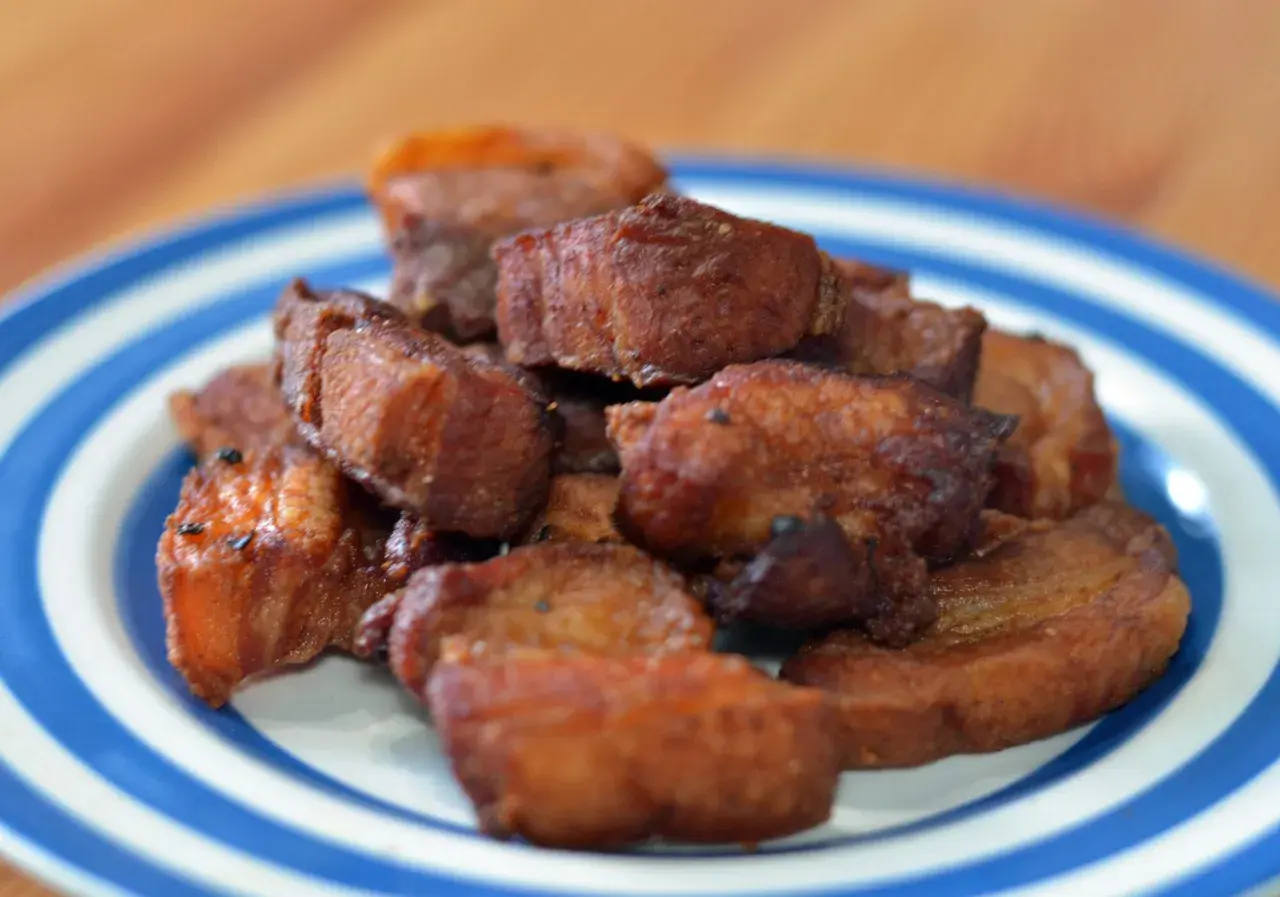
The cleanest answer to fried pork belly in Spanish is usually panceta frita, with torreznos as the more specific tapas-style name. The exact wording depends on whether you mean a plain fried belly cut, a crisp bar snack, or a regional dish with a very particular texture. I am going to separate those uses, show where the words overlap, and give you the safest phrasing for menus, ordering, and translation in a UK context.
The short version you can rely on
- Panceta frita is the broad, literal way to say fried pork belly.
- Torreznos is the more specific Spanish tapa, usually crisp and richly textured.
- Chicharrones can fit in some regions, but the meaning shifts a lot by country.
- If you need clarity for British readers, crispy fried pork belly is the safest English gloss.
- For ordering in Spain, using the Spanish name is usually better than trying to translate it on the spot.
The Spanish term that fits the dish
When I translate this dish, I start with the cut, then I move to the texture. If it is simply pork belly fried in a pan or deep-fried, panceta frita is the most straightforward Spanish phrase. If it is the classic crisp Spanish tapa with blistered skin and rich belly meat, torreznos is usually the better fit.
| Spanish term | Best English gloss | When I would use it | What to watch for |
|---|---|---|---|
| panceta frita | fried pork belly | Generic, literal, and easy to understand on a menu or in a recipe | Clear, but not very regional or evocative |
| torreznos | crispy fried pork belly | The Spanish tapa with a crackly exterior and juicy interior | More specific than a simple belly translation |
| chicharrones | cracklings, fried pork skin, or fried pork belly pieces | Only when the regional context makes the meaning obvious | The term changes a lot across the Spanish-speaking world |
If I only had room for one clear label, I would choose panceta frita for general use and torreznos when I wanted the dish to feel properly Spanish. That distinction matters, because the second term carries more culinary identity, not just a literal translation. The details behind that identity are where the real nuance lives.

Torreznos are the most specific answer
Torreznos are the word I reach for when the pork belly is meant to be crisp, salty, and deeply satisfying. The RAE treats torrezno as a piece of fried or fry-ready pork fat or bacon, which tells you something important: the term is tied to the treatment of the cut, not just to pork belly as a category. In practice, torreznos are usually thicker than bacon, more rustic than crackling, and better described as a tapas dish than as a breakfast meat.
That is why the texture matters so much. A good torrezno gives you contrast: a blistered, almost shattering exterior and a rich, juicy inside. If a dish is only lightly browned belly, I would not force it into the torrezno box. If the skin is what people remember, torreznos is the word that gives them the right expectation.
For a Basque-inspired restaurant or a menu that leans into Spanish food culture, I would keep the Spanish name visible and explain it once. That keeps the dish authentic without making the reader guess at what they are getting. From there, the regional differences start to make sense rather than feel confusing.
Region changes the word more than you might expect
Spanish food language is rarely one-to-one, and this is one of those cases where a clean dictionary translation can miss the way people actually speak. In some places, panceta is the broad term for pork belly itself, while in others it can lean closer to bacon-style meaning. In contrast, torreznos is far more anchored to the Spanish tapa tradition.
I would treat chicharrones carefully. In parts of the Spanish-speaking world it can mean fried pork skin, cracklings, or fried pork belly pieces, but it is not the default answer everywhere. If you are writing for Spain, or for a British audience trying to understand a Spanish menu, it is safer to use the more specific local name rather than assuming chicharrones means the same thing in every kitchen.
The biggest false friend here is bacon. In UK English, bacon suggests thin, cured slices served at breakfast, while Spanish fried pork belly is often richer, thicker, and meant to be eaten as a tapa or small plate. I would only use bacon if the dish genuinely behaves like bacon on the plate, and that is not usually the case. Once you accept that, ordering becomes much easier.
How I would order it in a bar
In a Spanish bar, I would keep the order simple and local. If I want the classic tapa, I would ask for unos torreznos, por favor. If I want to be more general, I would say panceta frita. The first is more natural when the kitchen knows the dish as a proper tapa; the second works when you want to describe the cut rather than invoke the specialty by name.
- “Unos torreznos, por favor.” Best when you want the tapa everyone recognises.
- “Tiene panceta frita?” Useful when you want a more literal pork-belly dish.
- “Es torrezno o panceta?” Handy when the menu description is vague and you want to confirm the style.
- Avoid “bacon” unless you are in a very informal setting and you know the person will understand the context.
If I were in a pintxos bar, I would expect the pork belly to be portioned as a small, high-impact bite rather than a heavy plate. That is typical of how Spanish bar food works: the dish is not just about protein, it is about texture, salt, and how well it sits alongside bread, wine, or beer. Knowing the word helps, but knowing the serving style helps even more.
The wording I would use on menus and recipes
For a UK-facing menu, I would choose the wording based on what matters most: authenticity or instant clarity. If the dish is central to the restaurant identity, I would write torreznos and add a short gloss such as crispy fried pork belly. If the audience needs an immediate understanding, I would lead with fried pork belly and keep the Spanish name in brackets or in the description.
| Context | My preferred wording | Why it works |
|---|---|---|
| Spanish menu | torreznos | Authentic, concise, and widely understood by diners who know the cuisine |
| UK menu | crispy fried pork belly (torreznos) | Clear for British readers while keeping the Spanish identity |
| Recipe heading | fried pork belly | Immediate and practical for home cooks |
| Heritage-led menu copy | torreznos with a short explanation | Best when the dish itself carries the story |
