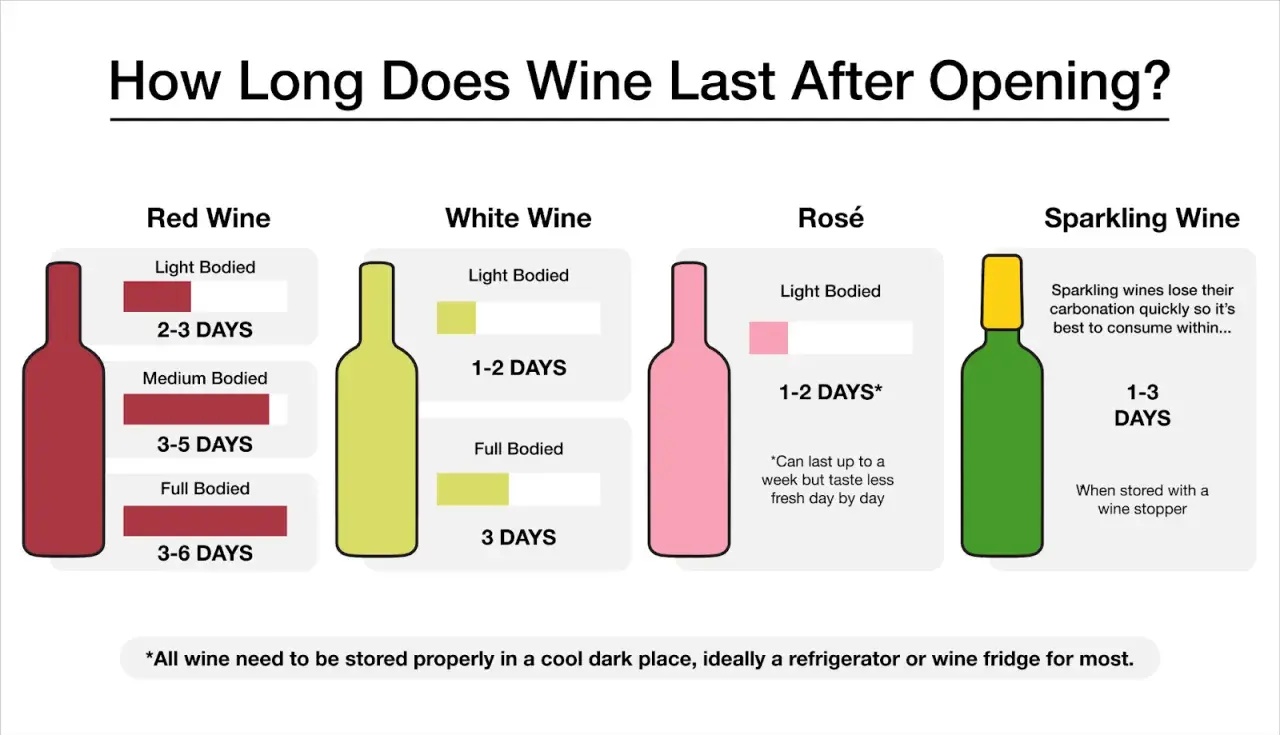
An open bottle does not suddenly become bad, but it does start changing the moment air gets in. The short answer to how long does wine last after opening is that most table wines stay pleasantly drinkable for about 2 to 5 days, with sparkling wine fading faster and fortified wine lasting much longer. I find the useful question is not just how long the bottle has, but what to do with it so the last glass still tastes worth pouring.
The simple rules worth remembering
- Most everyday wines are at their best for 2 to 5 days after opening if they are sealed again and chilled.
- Sparkling wine loses its edge fastest; without a proper stopper, it can go flat in hours.
- Red wine lasts longer than people think, especially if it is recorked and put in the fridge overnight.
- Sweet and fortified wines are the outliers; some can stay in good shape for weeks or even months.
- Heat, oxygen, and a half-empty bottle do most of the damage.
- If it smells vinegary, papery, or dull, it is past the point where I would serve it with confidence.
Why opened wine changes so quickly
Once a bottle is opened, oxygen begins working on the wine immediately. That is not always a bad thing in the first few minutes, because a little air can open up aromas, but after that the same process starts stripping away freshness and replacing fruit with flatter, more oxidised flavours.
Temperature speeds everything up. A bottle left on a warm kitchen counter changes much faster than one that goes back into a cold fridge, and this is true for red wine too. In the UK, people often assume reds should stay on the counter, but for an opened bottle I would rather chill it and let it warm slightly before serving again.
How much wine is left in the bottle matters as well. A bottle that is almost full has less air above the wine, so it usually holds up better than one with only one or two glasses left. That is why a half bottle fades faster than a nearly full bottle, even if both were opened at the same time. Once that is clear, the style-by-style time ranges become much easier to judge.
A practical shelf-life guide by wine style
There is no single rule that fits every wine, because acidity, sweetness, tannin, and alcohol all affect how fast the bottle falls off. I use the table below as a practical guide rather than a promise.
| Wine style | Typical window after opening | Best way to keep it | What usually happens |
|---|---|---|---|
| Sparkling wine | 1 to 3 days with a sparkling stopper | Fridge, upright, well sealed | The bubbles fade first, then the wine feels softer and less lively |
| Light white wine, rosé, and txakoli | 3 to 5 days | Fridge, original cork or stopper | Fresh fruit and floral notes disappear before the wine becomes obviously bad |
| Full-bodied white wine | 3 to 5 days | Fridge, tightly sealed | Often holds shape a little better, but it still loses brightness by day four or five |
| Light red wine | 2 to 4 days | Cool place or fridge, then let it warm before serving | Fruit softens quickly and the wine can taste tired before it smells spoiled |
| Full-bodied red wine | 3 to 5 days | Fridge, recorked, then temper before pouring | Tannin and structure help a bit, so these reds often survive better than lighter reds |
| Sweet and fortified wine | 1 to 4 weeks, sometimes longer | Cool, dark storage with a tight seal | Madeira and some fortified styles can last far beyond ordinary table wine |
If I had to give one conservative rule, I would say this: finish most ordinary wines within three days or move them into cooking. That is usually the point where the wine is still fine, but no longer clearly enjoyable. Fortified bottles are the exception, and that exception is big enough to remember because it changes the whole equation.
How to keep an opened bottle fresher for longer
The good news is that a few simple habits make a real difference. I do not think you need a cupboard full of gadgets, but I do think open wine should be treated like a perishable ingredient, not like a shelf-stable drink.
- Recork or reseal it immediately. The less time it spends breathing at the table, the slower the oxidation.
- Put it in the fridge, even if it is red. Cold temperature slows the chemical changes that flatten flavour.
- Store it upright. That keeps the exposed surface smaller and makes it easier to reseal cleanly.
- Transfer leftovers into a smaller bottle. Less air space means less oxygen working on the wine overnight.
- Use a vacuum stopper or inert gas if you have one. These tools can help, but they are useful additions, not magic.
- Avoid heat and sunlight. A bottle left near the hob, the oven, or a sunny window will tire faster than one kept cold and dark.
For a red, I usually chill the bottle first and bring it back to a serving temperature later. That sounds counterintuitive to some people, but it works well in practice. The same approach is useful in a Basque-style meal too: if you are serving a white with pintxos one night and plan to finish it the next evening, the fridge is your friend, not the enemy.
How to tell when it has gone past its best
There is a difference between wine that is no longer fresh and wine that is truly unpleasant. The first can sometimes still be cooked with; the second is just done. I rely on smell first, then taste, then appearance.
- It smells sour or vinegary. That usually means oxidation has gone too far.
- The fruit feels muted and flat. The wine may still be drinkable, but it will not feel alive in the glass.
- White wine turns darker and looks tired. A deeper gold or brownish tint is a warning sign, especially if it was pale to begin with.
- Red wine loses colour at the rim. Brick or orange tones are not always a problem in an aged wine, but in an open bottle they often mean the wine is fading quickly.
- The bubbles are gone. With sparkling wine, this is usually the first thing that makes the bottle feel disappointing.
- There is a harsh, papery, or stale finish. If the flavour dries out and turns lifeless, I stop treating it as a wine for the table.
I would not panic over a bottle that has simply lost some charm. That is common. What I would not do is keep forcing a wine that already smells like vinegar or tastes aggressively oxidised. At that point, it is past the point of useful service, which is exactly where the kitchen comes in.
When leftover wine belongs in the kitchen
This is where wine stops being a drinking decision and becomes a cooking ingredient. In a Basque kitchen, that can be a very practical shift. A bottle that is no longer bright enough for the glass may still be useful in a sauce, a braise, or a pan reduction.
Use a tired red for dishes that can handle depth and a little extra savouriness: stews, onion-based sauces, mushroom dishes, or a slow-cooked meat dish with peppers and tomatoes. Use a tired white for fish, shellfish, light broths, or a quick pan sauce. That works especially well with seafood-heavy plates, which is why a bottle that is slightly past its peak can still make sense alongside coastal Basque cooking.
What I would not do is cook with wine that has turned sharply vinegary. There is a difference between wine that is a little dull and wine that is genuinely off. If the bottle has crossed that line, it will not improve in the pan. But if it is only fading, cooking is often the smartest way to avoid waste and still get value from it.
The rule I use before I open the next bottle
My personal rule is simple: ordinary table wine gets two to three days of prime life, sparkling wine gets used quickly, and fortified wine gets a much longer leash. If I know I will not finish a bottle in that window, I do not wait and hope for the best; I seal it, chill it, and decide right away whether it is for tomorrow’s dinner or for the cooking pot.
That habit keeps the answer practical rather than optimistic. It also saves better bottles for the moments that matter, whether that is a relaxed meal at home, a plate of pintxos, or the last splash needed to finish a proper sauce. If the wine still smells fresh and tastes balanced, I pour it. If it does not, I stop negotiating and move on.