Wine legs are one of those details that look more mysterious than they really are. In practice, I treat the streaks that run down the inside of the glass as a clue about alcohol, sugar and serving conditions, not as a score for quality. This article explains what causes them, what they can and cannot tell you, and how to read them sensibly at the table.
The short version on what the streaks mean
- They are a physical effect caused by evaporation and surface tension, not a sign of magic in the glass.
- More visible trails often point to higher alcohol, sometimes to more residual sugar, but the room and glass also matter.
- They do not prove quality, price, age or prestige.
- A clean glass and a fair comparison make the pattern more useful.
- At the table, taste still matters more than the visual pattern.
What those streaks in the glass actually are
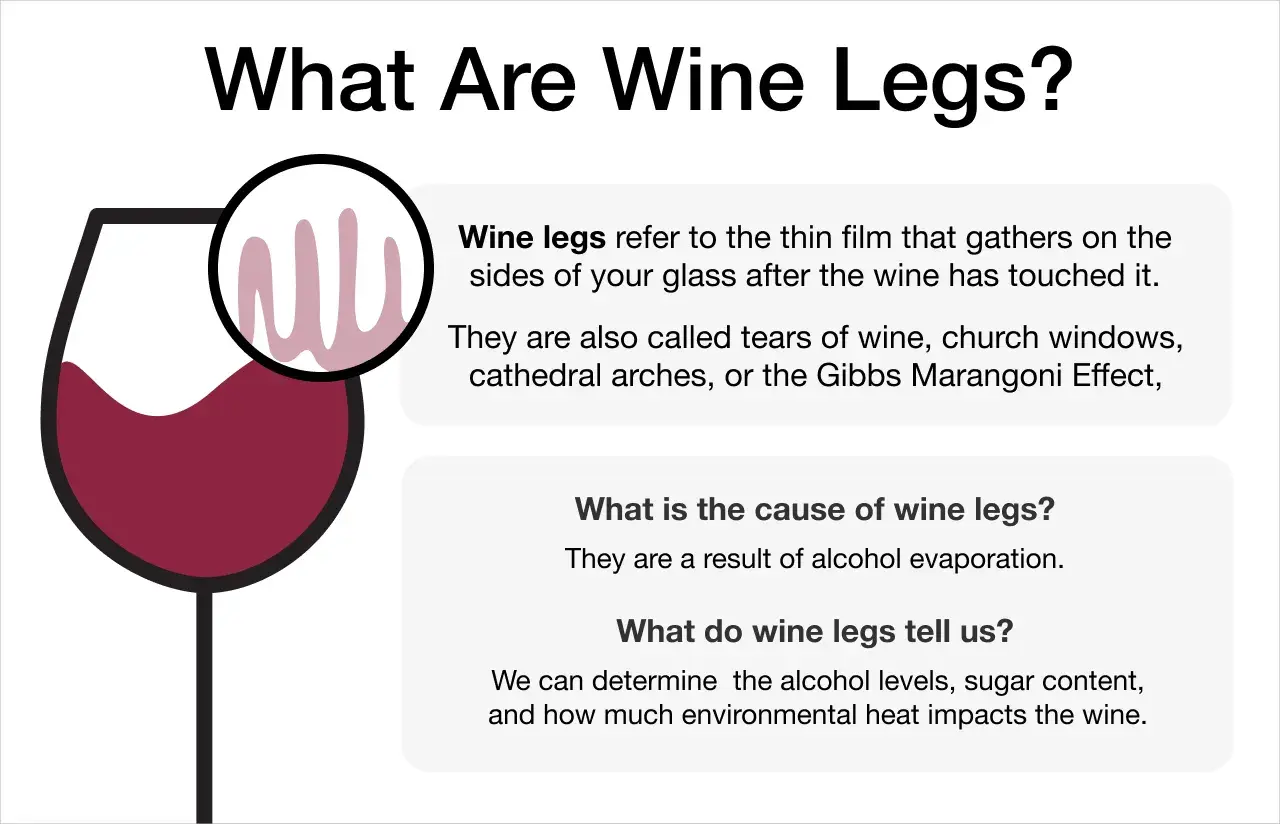
When I swirl wine, a thin film climbs the side of the glass and then gathers into droplets that slide back down. People call that effect tears of wine, church windows, or simply the marks left after a swirl. The science behind it is the Marangoni effect, which is a surface-tension shift created because alcohol evaporates faster than water.
That is the important distinction: the pattern is real, but it is not mystical. It is a visible side effect of the liquid changing on the glass, and it shows up most clearly when the wine, the room and the glass all make the effect easy to see. Once you know that, the next question is which variables make the pattern louder or quieter.
Why the pattern forms and what changes it
I find it easier to read the streaks when I think in terms of conditions rather than in terms of drama. The same bottle can look quite different depending on where and how it is poured.
- Alcohol level matters most. Higher-ABV wines often show a stronger effect because more alcohol evaporates from the glass edge.
- Residual sugar can make the liquid seem thicker and slower, so sweeter wines may leave more noticeable trails.
- Temperature changes the picture fast. A warmer room usually makes evaporation quicker, which can exaggerate the movement.
- Humidity and airflow also matter. Dry air and a bit of movement can make the pattern appear sooner and more sharply.
- Glass cleanliness is easy to underestimate. Detergent residue, grease or rough etching can distort the trails and make the whole thing less reliable.
That is why I never treat the same wine as a fixed visual object. It behaves differently in a cool cellar, a busy restaurant or a warm dining room, and that is exactly why the next step is figuring out what the pattern can genuinely tell you.
What the pattern can and cannot tell you
| What I see | What it may suggest | What I would not assume |
|---|---|---|
| Dense, slow-moving streaks | Higher alcohol, more residual sugar, or both | Superior quality |
| Thin, quick streaks | Lower alcohol or a lighter, drier style | Weak flavour or poor craftsmanship |
| Very obvious trails in a warm room | Fast evaporation and stronger surface-tension changes | That the wine is automatically richer |
| Broken or uneven trails | Dirty glass, detergent residue or a bad pour | Anything reliable about the wine itself |
The safest interpretation is the modest one. A more pronounced pattern often lines up with higher alcohol, and sometimes with a little more sugar, but I would never use it to judge whether a bottle is better than another. That is where people overreach, and it is also where a wine like Txakoli can be badly misunderstood: a brisk, lively Basque white may show modest trails and still be exactly right with pintxos, seafood or fried peppers. The useful part is the interpretation, and that is where most people overreach.
How I read them without fooling myself
When I actually want to use the glass as a clue, I keep the process simple. The trick is to remove as much noise as possible before trying to read the result.
- Use a clean glass with no visible detergent film or lipstick residue.
- Swirl once, then wait a few seconds so the film can settle.
- Compare wines of the same style rather than comparing a chilled white with a fortified dessert wine.
- Look at the spacing, thickness and speed of the trails, not just how many lines you can count.
- Use the pattern as a prompt to taste, not as the answer.
If the room is hot, the glass is warm or the humidity is low, I lower my confidence immediately. Those conditions can make a pattern look more dramatic than it really is, which is why I prefer to think of the streaks as an aid to tasting rather than a verdict on the wine. Once I strip away those distractions, I can use the clue more responsibly at the table.
When they matter at the table
In a restaurant, I only lean on the pattern when it helps me anticipate style. If I am choosing between two wines for a meal, a more persistent set of trails can hint at a fuller feel, a little more warmth, or a sweeter finish. That can be useful when I am matching wine to food that already has a strong texture of its own.
With Basque cooking, the context matters even more. A sharp, saline white with pintxos, anchovies or shellfish should feel refreshing first and expressive second; if its trails are modest, that does not weaken the wine, it simply fits the job. By contrast, a richer red beside grilled lamb, aged cheese or a deeper sauce may show a more pronounced pattern, and that can align neatly with the mouthfeel I expect. I care far more about balance than spectacle.
So I use the visual cue the way I use any quick dining clue: as support, not as the deciding factor. The wine still has to smell right, taste right and sit well with the dish in front of me. For me, that is the right balance: a small visual hint, not a scorecard.
The rule I keep when the glass starts telling stories
My rule is straightforward: if the streaks are striking, I note them; if they are faint, I let them go; if the room is hot or the glass is questionable, I ignore them altogether. The real judgement comes from aroma, balance and the way the wine behaves with food.
- Compare like with like.
- Trust the palate over the pattern.
- Use the streaks as a clue, not a verdict.
That is the practical value of the pattern in a wine glass: it is interesting, sometimes informative, and occasionally helpful, but only when I keep it in proportion to everything else the bottle has to offer.
