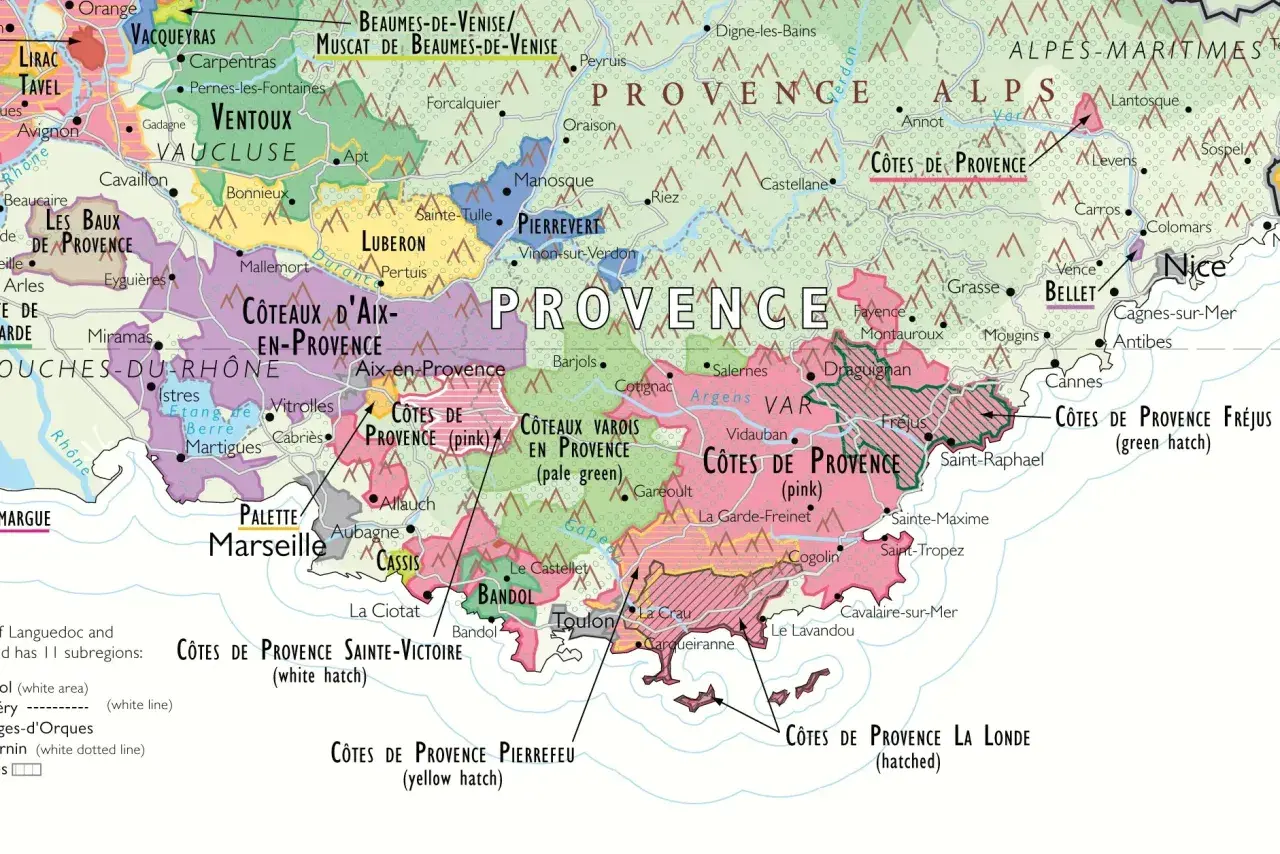
France’s wine geography is easier to understand when you treat it as a set of connected landscapes rather than a single national style. A good map shows where the classic zones sit, which grapes dominate, and why climate changes so sharply from the Atlantic to the Mediterranean and up into the hills. A French wine regions map is less about decoration and more about orientation, especially if you are choosing a bottle, planning a tasting trip, or pairing wine with a meal.
The quickest way to read France’s wine landscape
- Most practical maps start with about 8 to 11 headline regions and then drill down into roughly 360 appellations.
- Bordeaux, Burgundy, Champagne, the Loire, the Rhône, Alsace, Provence, the South West, Jura, Savoie, and Corsica are the names worth learning first.
- Climate and terrain explain more of the style than grape names alone.
- On French labels, the appellation often matters more than the varietal.
- For Basque food, the South West and nearby Pyrenean wines are especially relevant.
How to read the map without getting overwhelmed
I read French wine in layers: region first, then subregion, then appellation, then producer. That order matters because the country has roughly 360 protected wine designations, so no single map can show everything without becoming unreadable.
In 2026, most practical overviews still begin with roughly 8 to 11 headline regions and then break them into smaller wine zones. That is the right amount of simplification for a first pass, but it is not the whole story. A label that says Burgundy, for example, tells you the broad region; a label that says Chablis, Meursault, or Côte de Nuits gives you a much sharper clue about style.
When I use a map like this, I focus on three things:
- Where the region sits - coast, river, plain, or mountain.
- What climate it feels - cool, continental, maritime, or Mediterranean.
- How specific the label gets - region, village, cru, or single vineyard.
That simple habit stops the map from feeling decorative and turns it into a tool. Once you know how to read the layers, the major names start to make sense in a much more natural way.

The regions a useful overview should show
A serious map of French wine should not stop at the famous names. Bordeaux and Burgundy may get most of the attention, but the South West, Jura, Savoie, and Corsica are part of the real picture, and they matter if you care about variety, value, or food pairing.
| Region | What it usually signals | Typical grapes and styles | Why I pay attention |
|---|---|---|---|
| Bordeaux | Atlantic influence, river system, blended wines | Cabernet Sauvignon, Merlot, Cabernet Franc, plus dry and sweet whites | It is the clearest lesson in how blending shapes a region |
| Burgundy | Small parcels, site-first thinking, strong hierarchy | Pinot Noir, Chardonnay, with famous sites like Chablis and the Côte d'Or | It teaches terroir better than almost any other region |
| Champagne | Cool climate, chalk, sparkling wine | Traditional-method sparkling wines built mainly from Chardonnay, Pinot Noir, and Meunier | It shows how method and climate can define a style as much as grapes do |
| Loire Valley | Long river corridor with many microclimates | Muscadet, Chenin Blanc, Sauvignon Blanc, Cabernet Franc, and a broad range of styles | It is the best reminder that one region can hold many personalities |
| Rhône Valley | North-to-south contrast, spice, structure, warmth | Syrah in the north, Grenache-led blends in the south | It is a clean example of how one river corridor can produce very different wines |
| Alsace | Eastern slopes, rain shadow, aromatic precision | Riesling, Gewurztraminer, Pinot Gris, Pinot Blanc | It is one of the easiest regions for learning how climate sharpens white wine |
| Provence | Mediterranean light, herbs, coastal freshness | Rosé first, plus lighter reds and whites | It is the reference point for dry, food-friendly rosé |
| Languedoc-Roussillon | Large southern mosaic, value, experimentation | Blends, regional bottlings, and many local grape combinations | It is where scale and creativity meet |
| South West | Patchwork inland zone near the Pyrenees | Tannat, Malbec, Petit Manseng, Gros Manseng, and local varieties | It is the part of the map most people overlook, which is exactly why I keep coming back to it |
| Jura and Savoie | Alpine influence, smaller scale, distinctive local character | Savagnin, Chardonnay, Jacquère, Mondeuse | It proves that tiny regions can leave a very strong impression |
| Corsica | Island climate, sea breezes, native grapes | Fresh reds and whites with a Mediterranean frame | It adds a different island dimension to the French story |
If a map leaves out most of those names, it is showing the headline act but not the full cast. The point is not to memorise every appellation on day one; it is to recognise the family resemblance between wines before you ever open the bottle.
What geography tells you about taste
The broad rule is simple: cooler places usually hold more acidity, warmer places usually give riper fruit and softer tannins, and elevation often slows ripening enough to preserve detail. The technical word here is terroir, which means the combined effect of soil, slope, exposure, and climate on the final wine.
Atlantic west
Bordeaux and much of the western side of France feel the Atlantic first. That usually means more humidity, more blending, and more wines built for balance rather than brute force. It is one reason Bordeaux can produce both serious reds and elegant dry whites without looking like the same place in the glass.
Continental east
Burgundy, Champagne, and Alsace sit in a more continental frame, with sharper seasonal shifts. I look here for precision: bright acidity in Champagne, site sensitivity in Burgundy, and aromatic clarity in Alsace. The wines often feel more sculpted than broad.
Mediterranean south
Provence, Languedoc-Roussillon, the southern Rhône, and Corsica lean warmer and sunnier. That gives you fuller fruit, more spice, and, in many cases, softer tannin. It also explains why rosé works so naturally here: the climate supports freshness, but the light is strong enough to keep the wines generous.
Read Also: Sauvignon Blanc - Dry or Sweet? Unraveling the Taste
Mountain and alpine fringe
Jura, Savoie, and the Pyrenean zones behave differently again. Altitude and slope can preserve acidity, while local grapes keep the wines from tasting generic. I would not call these regions easy to read, but I would call them memorable, because they keep a strong sense of place.
That is the part of the map I find most useful in practice: it helps me predict style before I know the producer. Once that clicks, the bottles themselves become much easier to choose.
The bottles I would learn first
If I were building a working mental map, I would start with a few bottles or appellations that teach a region’s logic quickly. These are not the only good wines in France, but they are efficient teachers.
- Champagne - a non-vintage brut shows how acidity, texture, and dosage work together.
- Chablis - this is one of the cleanest lessons in Chardonnay without heavy oak.
- Médoc or Saint-Émilion - these show the difference between Cabernet-led and Merlot-led Bordeaux styles.
- Sancerre or Muscadet - Sancerre gives you precision and lift; Muscadet gives you salt, citrus, and a more Atlantic edge.
- Côtes du Rhône or Crozes-Hermitage - a simple way to compare the southern and northern Rhône logic.
- Alsace Riesling - bright, structured, and unmistakably regional.
- Bandol or Côtes de Provence - excellent for understanding why Mediterranean rosé became such a reference point.
- Irouléguy or Jurançon Sec - this is the South West at its most characterful, and it ties neatly into Basque food.
- Arbois or a Savagnin-based Jura wine - a small, high-character region that rewards curiosity.
- Patrimonio - a good entry point to Corsica’s island identity.
Once you have tasted even a few of those, the map stops feeling abstract. You start to hear the regions before you taste them, which is usually when French wine becomes much easier to enjoy.
Why the southwest matters for Basque food
This is the part of the map that feels closest to the table. The French Basque Country sits in the south-west corner of the country, so the wines there naturally lean into freshness, structure, and food value rather than sheer weight. For me, that is exactly what Basque cooking asks for.
The most important local name to know is Irouléguy. It is a small appellation, often built on steep slopes, and it produces red, white, and rosé wines that can handle dishes with salt, smoke, peppers, and rich sauces. Reds made with Tannat and Cabernet Franc bring grip and energy; the whites, often from Gros Manseng or Petit Manseng, can stay lively enough for fish, charcuterie, and sheep’s milk cheese.
That makes a practical difference at the table:
- Bayonne ham and charcuterie - I would reach for a fresh red with moderate tannin, not something heavily oaked.
- Anchovies, hake, or grilled fish - a crisp white from the South West or Loire keeps the salt and texture alive.
- Piperade and pepper-driven dishes - bright reds or aromatic whites work better than dense, extracted wines.
- Sheep’s milk cheese - this is where a structured white or a supple red can both make sense, depending on age and intensity.
If I were pairing wines for a Basque-style menu, I would use the map to avoid overpowered combinations. Heavy oak and high alcohol can flatten the herbs, peppers, and cured elements; cleaner acidity usually gives the food more room to breathe.
What I would keep in mind before buying the first bottle
The biggest mistake I see is assuming the map tells the whole truth. It does not. The map tells you the climate, the broad style, and the local tradition, but the producer, vintage, and appellation hierarchy still matter a great deal.
Here is the short version of how I would use it in real life:
- Use the region to choose the style, then use the appellation to narrow the profile.
- Check whether the label is broad regional wine or something more specific, because specificity often means more character and higher precision.
- Do not expect every southern French wine to be heavy or every northern wine to be lean; Bordeaux, Alsace, and Champagne all break lazy rules.
- Remember that Burgundy is often village-first, Bordeaux is usually blend-first, and the South West is where you meet the most surprises.
- For travel, pick one major region and one lesser-known area nearby; the contrast teaches more than trying to cover half the country at once.
If I were using a map to choose a bottle tonight, I would start with region, then appellation, then producer, and only then the grape. That sequence is the easiest way to turn a France-wide overview into a wine that actually fits the moment, the food, and the glass in front of you.
