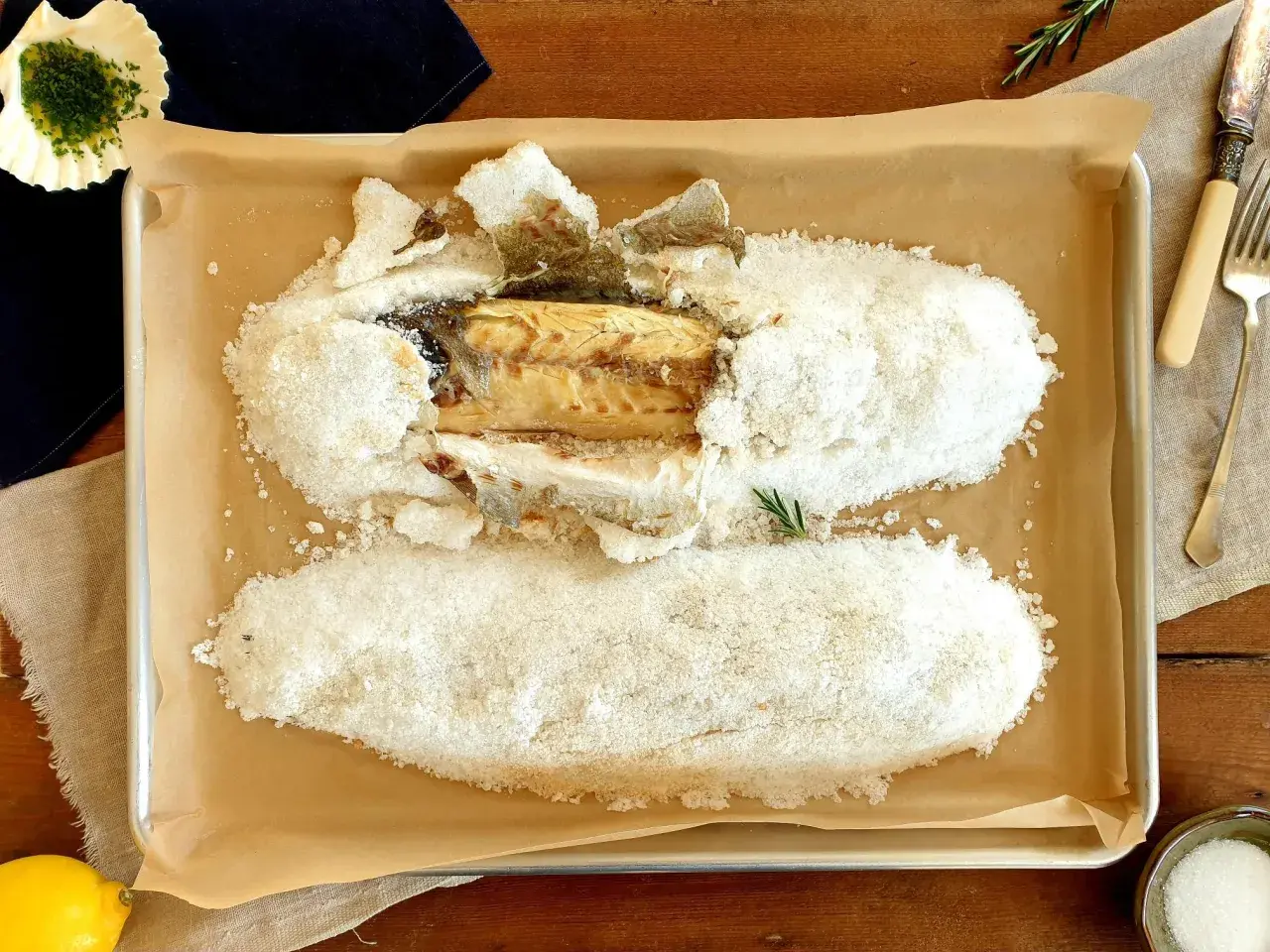
A salt crusted sea bass is one of those dishes that looks elaborate but behaves like straightforward cooking: the fish goes into a hot oven, the salt shell traps steam, and the flesh comes out tender, clean-tasting, and neatly cooked. In this guide I focus on the parts that actually matter at the table: choosing the right fish, building the crust, timing the bake, and serving it in a way that suits Basque-style seafood. If you want a dish that feels special without relying on a heavy sauce, this is the one worth getting right.
The main things to get right
- Choose a whole sea bass around 800 g to 1.5 kg for the easiest home result.
- Keep the filling restrained so the fish stays the focus.
- Mix the salt crust to damp sand with egg whites and a little water so it seals cleanly.
- Bake at 200°C conventional, 180°C fan, or Gas 6 and start checking early rather than late.
- Rest the fish for 5 to 10 minutes before cracking the shell.
- Serve it simply with potatoes, green vegetables, and a sharp dry white wine.
Why the salt crust works so well with sea bass
The method is less about salting the fish heavily and more about creating a sealed cooking chamber. As the fish heats, its natural moisture turns to steam inside the crust, which protects the flesh from drying out and gives you an even, delicate texture. Sea bass is a good candidate because it has fine flakes, a mild flavour, and just enough structure to hold up as a whole fish without becoming fussy.
That combination suits a Basque table especially well. In that style of cooking, I want the fish to taste like fish, not like a sauce wearing a disguise. The crust does the technical work while the finished dish stays clean, bright, and surprisingly restrained. Once that basic logic makes sense, the next question is how to choose the fish and prepare it without overcomplicating things.
How to choose the fish and keep the filling restrained
For home cooking, I like a whole sea bass in the 800 g to 1.5 kg range. Smaller than that, and the fish can feel lost under the crust; much larger, and the timing becomes less forgiving. In the UK, I would ask a fishmonger to gut it properly and remove the gills if that has not already been done. Scales are less important than cleanliness and dryness, but the skin should stay intact because it helps protect the flesh.
Keep the cavity simple. A few thin lemon slices, some parsley stalks, and a sprig or two of thyme are enough. If you start filling the fish with too many aromatics, the result can become muddled, and the salt crust is already giving you plenty of flavour support. I also dry the fish thoroughly inside and out before I do anything else, because excess moisture is the fastest way to get a patchy shell.
- Whole fish: 800 g to 1.5 kg is the easiest working range.
- Good filling: lemon, parsley, thyme, fennel fronds, or a bay leaf.
- Best prep: gutted, cleaned, and patted very dry.
- Useful rule: if the fish looks wet before it goes into the crust, fix that first.
Once the fish is clean and restrained, the actual build is simple, but it rewards accuracy more than speed.

How I build the crust and bake it
The version I trust most uses coarse sea salt, egg whites, and just enough water to make the mixture feel like damp sand. For a sea bass around 1.2 kg, I usually plan on about 1.5 to 2 kg of salt and 2 to 3 egg whites. If you want a more stable crust, a little lemon zest or finely chopped thyme can go in with the salt, but I would stop there. This is not the moment for herbs to take over.
- Heat the oven to 200°C conventional, 180°C fan, or Gas 6.
- Line a tray or roasting tin with parchment paper.
- Mix the coarse salt with the egg whites and a splash of water until it holds together when pressed.
- Spread a base layer of salt on the tray, set the fish on top, then cover it completely with the rest of the mixture.
- Press the crust gently so there are no gaps, especially around the head, tail, and belly cavity.
- Bake until the crust is hard and the fish is just cooked through.
- Rest the fish for 5 to 10 minutes, then crack the shell and lift the skin away before serving.
For a fish in the 800 g to 1 kg range, I start checking at about 25 minutes. At 1.2 to 1.5 kg, 30 to 35 minutes is more realistic. A slightly larger specimen may need closer to 40 minutes, but I would still check early rather than trust the clock blindly. The crust should look dry and slightly matte, not damp or sandy, and the fish should be ready to come apart in clean flakes.
How to judge doneness and avoid the two common mistakes
The two errors I see most often are under-sealing and overcooking. Under-sealing happens when the crust is too thin or the fish is still wet, which lets steam escape and gives you uneven cooking. Overcooking happens when someone assumes the crust makes timing irrelevant, which it does not. It protects the fish, but it does not stop the clock.
If you use a thermometer, I aim for about 55 to 60°C at the thickest part for juicy flesh. Above that, the texture becomes firmer and less delicate, which may be fine for some diners but is not the point of this dish. Without a thermometer, look for flesh that has turned opaque and begins to pull cleanly from the backbone. The fish should still feel supple, not dry and rigid.
| What you see | What it usually means | What I would do |
|---|---|---|
| Hard, dry crust and opaque flesh | The fish is likely ready | Rest it briefly, then open the shell |
| Crust still damp or soft in places | The seal may not be complete | Give it a few more minutes in the oven |
| Translucent flesh near the backbone | The centre needs more time | Return it to the oven and check again soon |
| Very firm flakes and dry edges | It has gone past ideal | Serve immediately and keep the rest of the menu light |
Once you can read the fish correctly, the dish becomes much easier to serve well, which is where the Basque-leaning side of the meal starts to matter.
What to serve with it in a Basque-style meal
I would keep the plate bright and simple. Basque seafood cooking tends to respect the fish rather than bury it, and this method fits that idea neatly. A few boiled new potatoes with olive oil and parsley give you something starchy without competing with the bass. Charred peppers, green beans, courgettes, or a small salad with sherry vinegar all work because they add freshness rather than weight.
For wine, a dry, high-acid white is the safest choice. Txakoli is the classic Basque answer if you can find it, but a crisp English white, Albariño, or Muscadet will do the same job. The goal is not a flashy pairing; it is something that cuts through the richness of the olive oil and keeps the palate moving.
- Best starch: new potatoes with olive oil, parsley, and a little flaky salt.
- Best vegetables: charred peppers, green beans, courgettes, or fennel.
- Best acidity: sherry vinegar in a simple salad dressing.
- Best wine style: dry, mineral, and refreshing rather than oaky or sweet.
If you are still deciding whether the salt crust is worth the effort, the quickest way to judge it is by comparing it with the other whole-fish methods you might use instead.
When this method beats roasting, and when it does not
I reach for a salt crust when I want the fish to be the centrepiece, the texture to be especially moist, and the moment of cracking it open to feel a little theatrical. I do not reach for it when I want the skin to go crisp, when I am cooking a very small fish, or when I need a quicker weeknight meal. There is nothing wrong with plain roasting; it simply solves a different problem.
| Method | Best for | Result | Trade-off |
|---|---|---|---|
| Salt crust | Dinner parties and whole-fish presentation | Very moist, delicately seasoned flesh | More salt, more cleanup, no crispy skin |
| Whole roast | Weeknight cooking and quicker service | Direct flavour with bronzed skin | Easier to overcook if the oven runs hot |
| Parchment bake | Light, aromatic cooking with minimal mess | Gentle, clean, softly steamed texture | Less dramatic and less protective than a crust |
For me, the deciding factor is usually the occasion. If the fish is meant to anchor the meal, the crust earns its place. If I mainly want speed or crisp skin, I choose another route.
Small details that make it feel like a restaurant dish at home
The dish becomes noticeably better when the small things are handled well. I weigh the fish before buying or ordering the salt, because cooking time follows the fish, not the recipe headline. I also make the crust mixture just damp enough to hold together, since a sloppy mix tends to slump and a dry one cracks before it seals.
- Keep the fish as dry as possible before it goes into the salt.
- Use parchment so the crust lifts cleanly from the tray.
- Set the table before the fish comes out of the oven, because the cracking moment is best when everything else is ready.
- Have a serving spoon and fish slice nearby so the flesh comes off the bone in neat portions.
- Finish with good olive oil, lemon, and a handful of herbs rather than a heavy sauce.
If I were building a Basque-leaning dinner around this fish in the UK, I would keep the rest of the menu quiet and let the sea bass carry the evening. That restraint is what makes the dish feel polished rather than complicated, and it is also why the salt-baked approach still has a place on a modern table.
