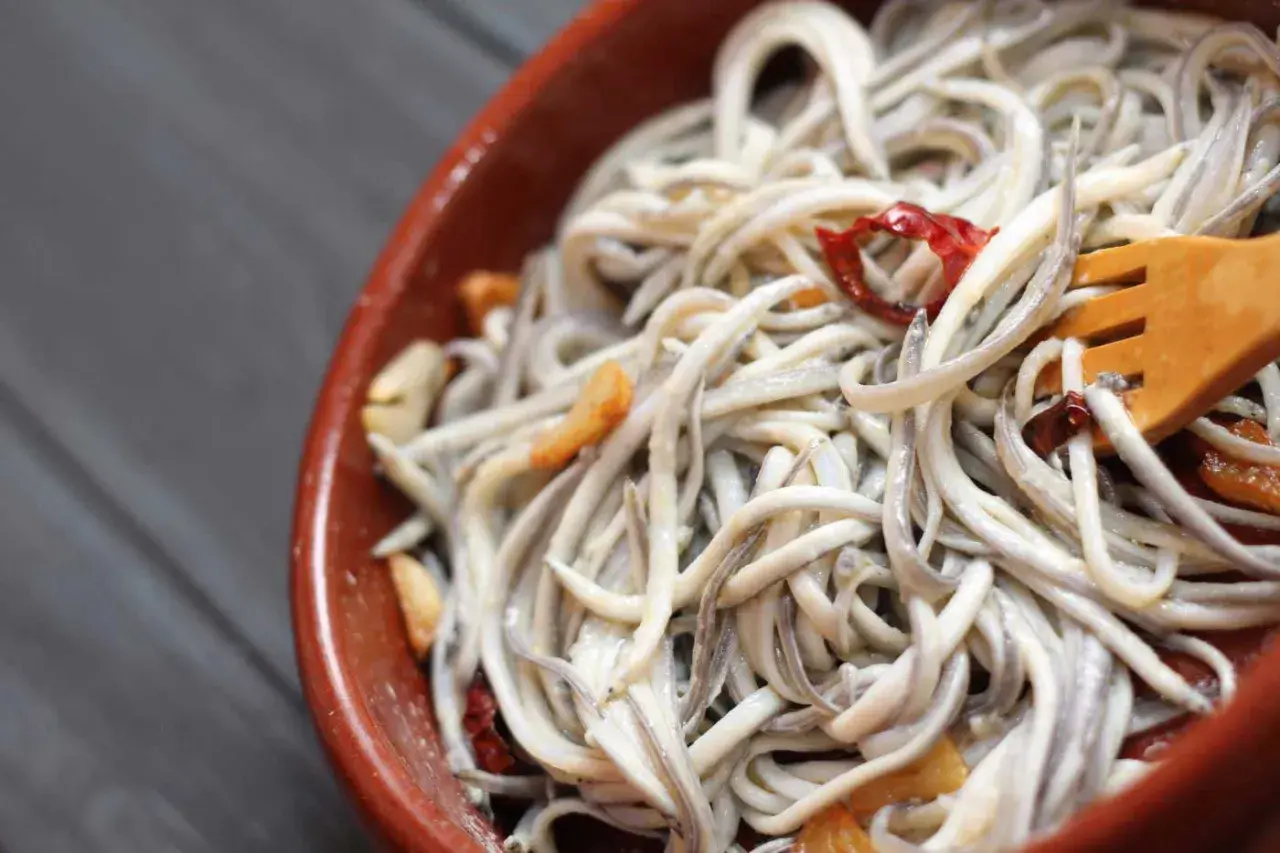
In Basque cooking, a little eel can be one of the most talked-about seafood ingredients on the table. This article explains what it actually is, why it matters in dishes like angulas a la bilbaína, how it differs from gulas and adult eel, and what I would look for when buying or ordering it in the UK. I’ll also cover the cooking style, the flavour profile, and the sustainability questions that matter in 2026.
What matters most before you buy or order it
- The term usually refers to elvers, the juvenile stage of eel, not a full-grown fish.
- Basque cooking keeps the preparation minimal: olive oil, garlic, and a little chilli are the classic formula.
- Genuine angulas are scarce and expensive, while gulas are the common surimi-based substitute.
- The flavour is delicate, lightly sweet, and briny, so heavy sauces usually work against it.
- In the UK, provenance matters because European eel is still under serious conservation pressure.
What this seafood actually is
In British seafood language, this is usually an elver, also called a glass eel at an early stage. It is the juvenile form of eel, often only a few centimetres long, translucent when young, and moving through estuaries before it darkens and grows into a stronger, oilier fish. I find that distinction useful because it changes how you should think about the ingredient: this is not a “mini eel” in the casual sense, but a specific life stage with its own texture and value.
That is why the dish feels so delicate. The strands are tiny, soft, and fast-cooking, and the eating experience is closer to a refined seafood garnish than to a conventional fillet or smoked fish. Once you understand that, the Basque approach starts to make sense, because the cooking is designed to protect the ingredient rather than overpower it. That takes us straight to the tradition that made it famous.
Why Basque cooks prize it so highly
In the Basque Country, the appeal is restraint. The classic preparation, angulas a la bilbaína, keeps the focus on hot olive oil, sliced garlic, and a little chilli, so the seafood stays soft and clean-tasting instead of being buried under sauce. The method is simple on purpose, and I think that simplicity is part of the luxury: when the ingredient is scarce and fragile, the cook has to show discipline.
Traditionally, it is served immediately in a preheated earthenware dish so the texture reaches the table intact. That is also why the dish feels more like a seasonal ritual than an everyday starter. It is a winter plate, a celebratory plate, and, in the best cases, a plate that says the kitchen trusts the ingredient enough to leave it alone. Once you know that, the next question is obvious: what exactly is on the plate when menus use different names?
Angulas, gulas, and adult eel are not the same thing
This is where many people get misled, so I keep the distinction very clear when I explain the dish to guests.
| Product | What it is | Flavour and texture | Best use | Practical note |
|---|---|---|---|---|
| Angulas / elvers | Juvenile eel, tiny and translucent | Very delicate, lightly sweet, briny | Classic Basque starter | Scarce, high-priced, and conservation-sensitive |
| Gulas | Surimi imitation made to resemble angulas | Milder, springy, less refined | Affordable tapas and home cooking | A sensible substitute when the genuine product is unavailable |
| Adult eel | Fully grown eel, usually grilled, smoked, or stewed | Richer, oilier, meatier | Main course or stronger-flavoured dishes | Different product, different eating experience |
I think this is the clearest place to separate tradition from marketing. If a kitchen serves gulas, that is not automatically a compromise in the bad sense; it is simply a different product with a different price point and a different purpose. What matters is honesty. Once you know what you are actually buying, the cooking method becomes much easier to judge.
How to cook and serve it without flattening the flavour
The safest method is the simplest one. Warm good olive oil gently, soften sliced garlic until it is pale gold, add a small chilli if you want the traditional Basque lift, and fold in the eel or substitute only at the end. For genuine elvers, I would keep the finish to about a minute once the pan is ready; for gulas, a little longer is acceptable, but the principle is the same: heat it through, do not overwork it.
- Use a wide pan or cazuela so the strands stay separate.
- Keep the seasoning sharp and clean; this dish dislikes heavy cream, tomato, or strong smoke.
- Serve it immediately with toasted bread or on its own as a starter.
- Pair it with a dry white wine, a crisp Basque-style Txakoli, or a bright cider rather than an oaky wine.
- If you are using gulas, they can take a touch more handling, but they still taste better when cooked briefly.
My own rule is simple: the smaller and more delicate the ingredient, the less you should ask it to do. If the pan has too much going on, you stop tasting the seafood and start tasting the garnish. That is a useful test in the kitchen, but it is not the only one. Buying well matters just as much.
What to buy in the UK without getting misled
In the UK, genuine elvers are rarely an everyday retail item, so I would be cautious with any label that sounds vague. Look for the species name if it is supplied, the product form, the origin, and whether you are buying a preserved luxury item or a surimi imitation. If a listing says only “seafood strands” or “eel-style”, that usually tells you more about marketing than about quality.
Specialist Spanish delis, fishmongers, and import-focused food shops are the most likely places to stock something in this family, but even then I would check the description twice. Price is another clue: real angulas are luxury seafood, not bargain seafood, and a suspiciously cheap product is usually a sign that you are looking at gulas or something even further from the original. I am much more interested in clarity than in a fancy label, because the next issue is bigger than taste.
The cleanest way to enjoy the Basque idea responsibly
The conservation reality is hard to ignore. The European eel remains critically endangered, and UK authorities have tightened permissions around elver fishing in 2026. The Marine Conservation Society still advises consumers to avoid European eel, which is why I treat provenance as part of the recipe, not an afterthought.
That does not mean the Basque tradition is off limits as a culinary idea. It means you need to be deliberate. If you cannot verify source and legality, I would choose gulas or another small, quickly cooked seafood, and keep the same garlic-oil-chilli logic. The point of the dish is not to force a rare ingredient onto the plate; it is to preserve a very specific style of cooking.
When I cook or order something in this family, I look for three things: a short ingredient list, a kitchen that can explain what is on the plate, and a preparation that respects the product’s size. That is enough to keep the experience honest, and it is usually enough to tell whether the dish is worth the price and the attention it asks from you.
