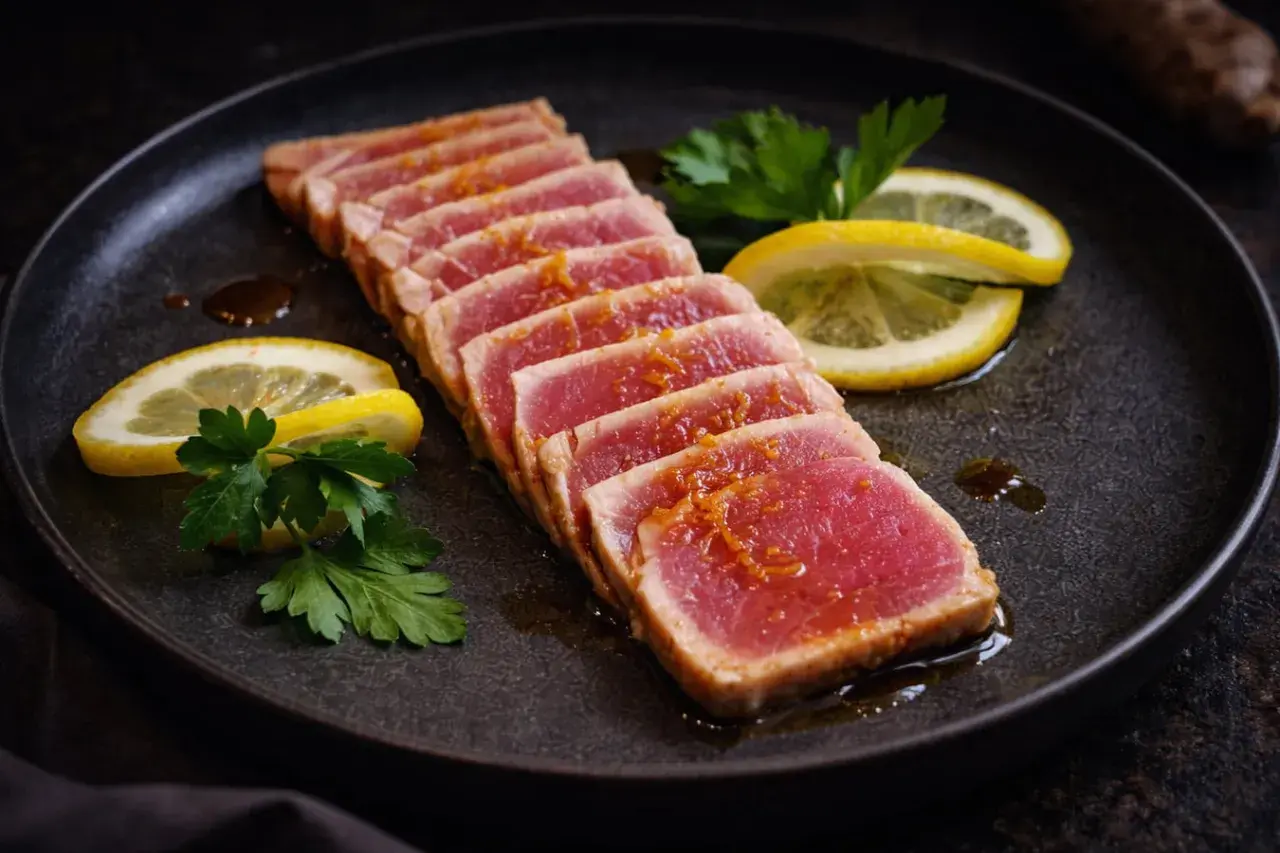
A good plate of tuna tataki is all about contrast: a hard, fast sear outside and a cool, ruby centre inside, sliced thin so every bite gets both textures. I want this article to show what the dish is, how I choose and cook the fish, and how I finish it so it feels polished rather than fussy. I’ll also keep it grounded in the way I like to serve seafood in a Basque-leaning kitchen: clean flavours, sharp acidity, and enough restraint to let the tuna speak.
What matters most before you plate it
- The best version depends on high heat, a very short sear, and thin slicing.
- A thick tuna steak, usually about 2.5-3 cm, gives the cleanest contrast between crust and centre.
- I aim for roughly 15-30 seconds per side, depending on thickness and pan heat.
- Sharp knife work matters more than elaborate garnish.
- Bright, salty, acidic accompaniments keep the seafood character intact.
- In the UK, source quality and cold-chain handling matter just as much as technique.
Why the contrast matters
The reason this style of tuna works is simple: it gives you two textures at once. The outside should taste savoury and lightly caramelised, while the centre stays almost sashimi-soft, which is why thin slicing is not a decorative detail but part of the dish itself.
| Style | How it is cooked | Texture | Best use |
|---|---|---|---|
| Tataki-style tuna | Quickly seared outside, barely touched inside | Crusty edge, cool centre | Light starter or elegant seafood main |
| Sashimi | No searing | Purely raw throughout | Very fresh fish with minimal dressing |
| Fully cooked tuna steak | Cooked through or nearly through | Firmer, meatier, less contrast | Heavier main course, grilled plates |
For me, the lesson is that this dish lives or dies on restraint. If the centre turns opaque all the way through, you still have tuna, but you no longer have the tension that makes the dish memorable.
How I choose the fish in the UK
If I am buying tuna for this dish, I want a thick loin or steak with a deep red colour, a firm surface, and a clean sea smell. I would rather buy a smaller amount from a fishmonger I trust than a bigger, cheaper cut with a weak cold chain, because quality is doing most of the work here.
The Food Standards Agency notes that tuna can be served rare when it has been correctly frozen and fully seared on the outside, so I always ask how the fish was handled before it reached the counter. I also prefer pieces that are at least 2.5 cm thick, because thin steaks overcook too quickly and leave you with no margin for error.
| What I check | What good looks like | Why it matters |
|---|---|---|
| Colour | Deep ruby to dark pink, not dull brown | Signals freshness and better flavour |
| Texture | Firm, springy flesh | Helps the steak hold together when sliced |
| Smell | Clean and ocean-like | A strong fishy or sour smell is a warning sign |
| Thickness | About 2.5-3 cm | Makes a fast sear possible without overcooking the centre |
| Handling | Kept properly chilled, with clear origin | More important than marketing labels |
I do not put much weight on trendy labels. What matters is that the fish has been handled well, stays cold until cooking, and is substantial enough to take a hard sear without collapsing.

How I sear it without losing the centre
This is the part where people usually overthink the method and undercook the heat. I use a heavy pan, a thin film of high smoke-point oil, and very little patience; the whole point is to hit the surface hard enough to brown it before the heat can travel too far inward.
- Pat the tuna dry and season lightly with salt and pepper just before it hits the pan.
- Heat the pan until it is very hot, ideally around 220-230°C on the surface if you use a thermometer.
- Add enough oil to coat the base in a thin sheen, not a puddle.
- Sear for about 15-20 seconds per side for a 2.5 cm steak, a little longer only if the piece is thicker.
- Turn briefly onto the edges if they are still pale.
- Rest for 1-2 minutes, then slice while the centre is still cool and the surface is not steaming.
I avoid long marinades before searing. Soy, citrus, or vinegar left on the fish for too long starts to cure the surface and softens the crust, which is exactly the wrong direction for this dish. If I want sesame, I press it on lightly so it clings without burning.
How I slice and plate it like a restaurant dish
The knife does more damage than the pan if you rush this part. I use a very sharp blade, slice across the grain at a slight angle, and keep the pieces around 5-8 mm thick so the contrast still shows in each slice.
- Wipe the knife between cuts so the edge stays clean.
- Cut in one smooth motion instead of sawing through the flesh.
- Fan the slices on the plate with a small overlap.
- Put sauce under or around the fish, not all over it.
- Finish with a few sharp elements such as spring onion, radish, chives, sesame, or herbs.
I like to serve it soon after slicing, when the centre still looks cool and the outer edge has just enough warmth to carry the sear. If I wait too long, the contrast softens, and the plate loses some of its impact.
Basque-friendly pairings that keep the fish central
Because this site lives close to Basque food culture, I would keep the accompaniments bright, peppery, and restrained rather than leaning into heavy sauces. Tuna has enough character on its own, so the best pairings frame it instead of competing with it.
| Basque-style element | How I use it | Why it works |
|---|---|---|
| Piquillo peppers | Serve in a small salad with olive oil and a little salt | Add sweetness and a gentle smokiness |
| Charred green peppers | Scatter alongside the tuna with flaky salt | Bring bitterness and a grilled note without heaviness |
| Txakoli or dry cider | Serve chilled in a small glass | The acidity cuts through the richness cleanly |
| Piperade-style vegetables | Use a thin spoonful underneath the fish | Gives warmth, tomato, and pepper depth without masking the tuna |
| Lemon, parsley, chive | Finish at the last second | Sharpens the seafood flavour and keeps the plate lively |
I avoid heavy aioli, creamy dressings, and sugary glazes here. They flatten the fish, blur the sear, and make the dish feel less like seafood and more like a sauce delivery system.
Mistakes I would avoid every time
The biggest mistakes are practical, not exotic. They usually come from trying to force a delicate fish into the logic of a thick steak.
- Using a thin cut, which cooks through before the surface can brown properly.
- Starting with a pan that is only warm, not properly hot.
- Leaving a wet marinade on the fish and losing the crust.
- Using a dull knife, which tears the slices and makes the centre look messy.
- Letting the fish sit warm for too long before or after cooking.
If the fish smells off, looks faded, or has been stored carelessly, I do not try to rescue it with seasoning. That is not caution for its own sake; tuna is too delicate to hide problems, and the texture will punish you immediately. For anyone cooking for pregnant guests, very young children, or people with weakened immunity, I would choose a fully cooked seafood dish instead of a rare preparation.
The version I keep coming back to when I want it to feel complete
The plate I return to most often is the simplest one: a thick tuna loin, a fast sear, a thin slice, a little citrus, and one crisp green element. If I want a Basque note, I usually add a small piquillo pepper salad or charred peppers rather than building a sauce that takes over the dish.
That approach keeps the seafood flavour clear while still giving the plate enough brightness to feel finished. If you get the heat, the knife work, and the seasoning right, the rest is just restraint, and that is usually what makes this kind of tuna taste expensive without being showy.
