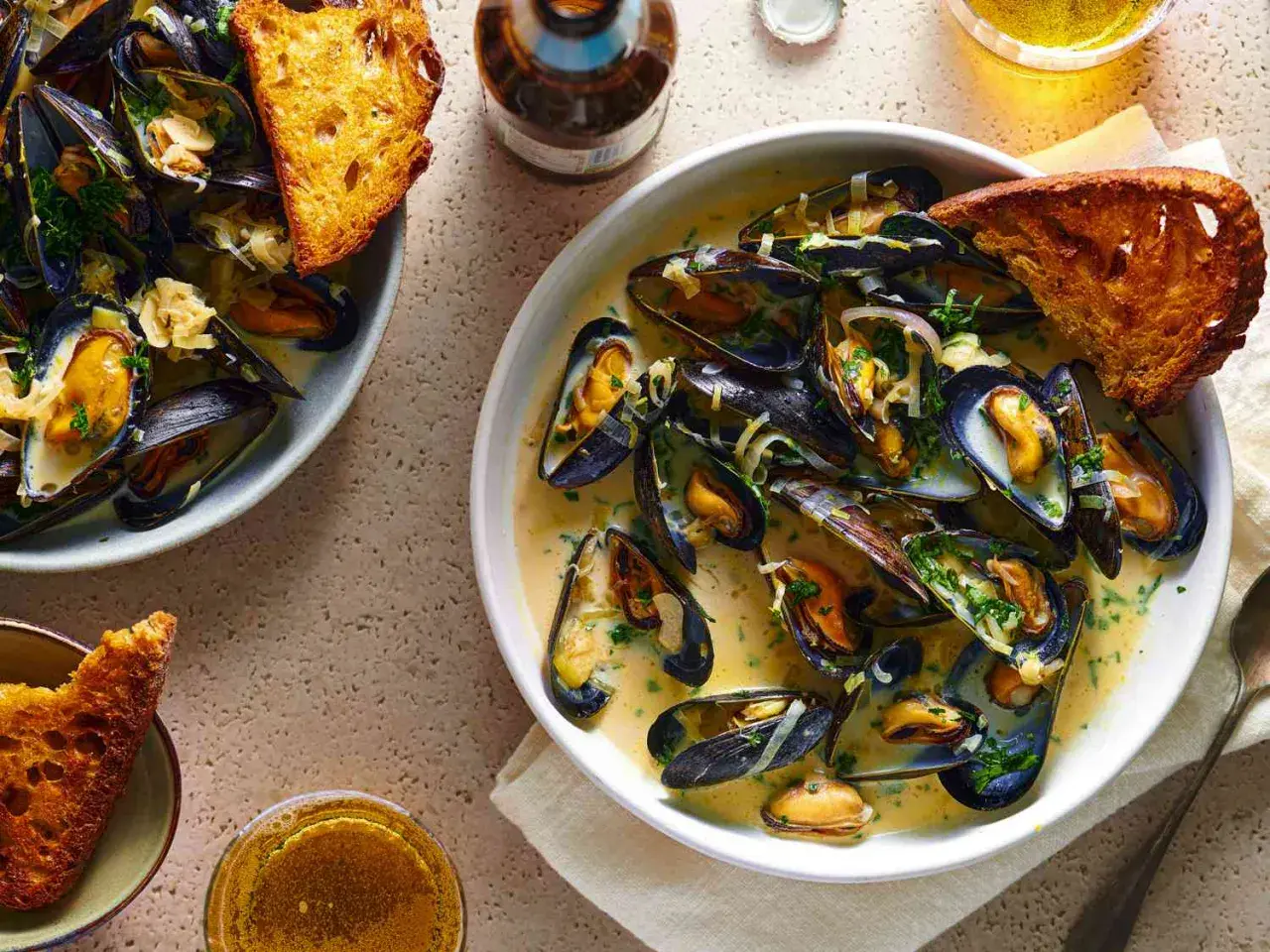
Fresh mussels need very little to become memorable: a hot pan, a dry white wine, softened shallots, and enough butter to round the broth without hiding the shellfish. That balance is the whole appeal of moules marinière, and it is why I still recommend it when someone wants a seafood dish that feels both simple and polished. In this guide I’ll cover what the dish is, how to choose and cook the mussels, where the common mistakes creep in, and how I would serve it in a UK kitchen.
The essentials for a clean, briny bowl
- Use live mussels, discard cracked shells, and throw away any that stay open after a firm tap before cooking.
- A dry white wine, shallots, butter, and parsley are enough; garlic is optional, not essential.
- Once the mussels hit the pan, they usually need only 4-5 minutes under a lid.
- Any mussels that do not open after cooking should be left out of the bowl.
- Crusty bread, fries, or a simple green salad are the cleanest sides.
- A crisp Atlantic-style white wine works better than anything heavily oaked.
Why this classic still earns a place on the table
I like this dish because it does not try to do too much. The mussels bring the salt and sweetness, the wine brings acidity, the shallots give gentle depth, and the butter ties everything together into a broth you actually want to mop up. That is a useful lesson in seafood cookery: when the ingredient is already good, the job is to frame it, not overpower it.
It is also one of the easiest ways to serve something that feels restaurant-level without turning dinner into a project. If you cook for friends, it arrives fast, looks generous, and gives you a clear signal of care. The same discipline is what makes so much Atlantic coastal cooking compelling, Basque food included: short cooking times, clean flavours, and no unnecessary clutter.
Once you understand that logic, the ingredient list starts to make sense in a very practical way.
The ingredients I rely on
For a version that tastes clean rather than heavy, I keep the ingredient list short. The exact quantity can scale, but the ratios matter more than most home cooks realise.
| Ingredient | My starting point for 2 people | Why it matters |
|---|---|---|
| Live mussels | 1 kg | Enough for a main course with broth and bread |
| Shallots | 2 medium | Sweeter and softer than onion, so the sauce stays refined |
| Dry white wine | 150-250 ml | Gives lift and a clean shellfish aroma |
| Butter | 25-50 g | Rounds the broth without making it creamy |
| Flat-leaf parsley | 1 small handful | Freshens the finish and keeps the bowl bright |
| Black pepper | To taste | More useful than extra salt in most cases |
| Optional garlic | 1 small clove | Works in moderation, but should never dominate |
I look for mussels that smell clean and sea-like, with shells that are shut or close when tapped firmly. The shell test matters: cracked shells go, and any open shell that stays open after that tap goes too. For the wine, I look for something dry and unoaked. Muscadet, Picpoul, Albariño, a crisp English white, or a txakoli, the bright lightly spritzy Basque white wine, all make sense because they keep the broth bright. I avoid anything sweet or heavily oaked; those styles flatten the shellfish rather than sharpen it.
Once the ingredients are right, the method is straightforward.
How I cook it without overthinking it
The whole dish can be done in about 15-20 minutes, but the order matters. I use a large, deep pan with a lid so the mussels steam evenly instead of sitting in a cramped heap.
- Rinse the mussels quickly under cold running water, scrub away grit, pull off any beards, and discard cracked shells. If a shell stays open after a firm tap, I throw it away.
- Melt the butter over medium heat and soften the shallots with a pinch of salt for 3-4 minutes. I want them tender, not browned.
- Turn the heat up, add the mussels and pour in the wine. Cover the pan and cook for 4-5 minutes, shaking once or twice, until the shells open.
- Take the pan off the heat, add the parsley and black pepper, and remove any shells that never opened.
- Spoon the mussels and broth into warm bowls and serve immediately with bread, fries, or both.
The part most people rush is the final minute. I do not keep mussels on the heat because they have opened; I stop as soon as the job is done. That is the difference between tender shellfish and something chewy, and it is why the cooking liquor, the broth left in the pan, matters so much. It is not a separate sauce; it is part of the dish.
The biggest failures are usually not about flavour, but about timing and handling.
The mistakes that usually spoil the bowl
- Overcooking is the fastest way to ruin them. Four to five minutes is usually enough once the lid goes on.
- Using the wrong wine changes the whole dish. Sweet or woody wine makes the broth dull and heavy.
- Salting too early is unnecessary because mussels and the cooking liquor already bring natural salinity.
- Crowding the pan can leave some shells under-steamed while others overcook. If you have a lot, use a wider pot or cook in batches.
- Keeping dead shells is a safety issue, not just a flavour issue. Anything cracked, damaged, or stubbornly open before cooking should go.
- Turning it into a cream sauce by accident loses the point of the dish. A splash of cream can be a deliberate variation, but it is no longer the clean, wine-led version I would call classic.
If the broth tastes slightly flat at the end, I reach first for a little black pepper or a few drops of lemon, not more salt. That keeps the balance in place and leads naturally into the question of what should sit beside the bowl.

What I serve with it in a UK kitchen
The dish is flexible, but the sides should do one job: catch the broth and keep the meal lively. I almost always want something crisp, something fresh, or both.
| Side or drink | Why I choose it |
|---|---|
| Crusty bread | The simplest way to use the broth without distracting from the mussels |
| Fries | Turns the bowl into a proper pub-style meal and gives you texture against the soft shellfish |
| Green salad with a sharp dressing | Balances the butter and keeps the plate from feeling too rich |
| Boiled new potatoes | A good option when you want something filling but less greasy than fries |
| Dry white wine or sparkling cider | Resets the palate and keeps the seafood flavour clean |
If I want the meal to lean a little more Basque, I might add grilled peppers or a simple piperade, the Basque pepper-and-tomato stew, on the side. That keeps the plate in the Atlantic family without smothering the mussels in extra sauce. For me, that is the right kind of evolution: respectful, flavour-led, and still recognisably the same dish.
Where a Basque twist fits and where it doesn't
I like the wine-steamed method precisely because it leaves room for a controlled twist. A small pinch of piment d'Espelette adds gentle warmth, a spoonful of finely diced roasted pepper adds sweetness, and a little garlic gives the broth more edge. Those changes still respect the shellfish.
What I would not do is throw in every Mediterranean signal at once. Too much chorizo, too much cream, too much paprika, or too much tomato pushes the dish away from its identity. The best versions are the ones that stay aware of the mussel first and the garnish second.
- Good Basque-style touches are piment d'Espelette, roasted peppers, parsley, and a dry local white.
- Risky additions are heavy cream, smoked sausage, or a sauce so busy that the broth disappears.
- Best use case is a coastal menu where you want one plate that feels familiar but not repetitive.
That is why I see this dish as a bridge rather than a detour: it keeps the seafood central, but it can still sit comfortably beside Basque flavours when the hand stays light.
The small details that make it feel finished at home
The last bit of polish usually comes from restraint. I warm the bowls, keep the lid off only after the mussels have opened, and pour every drop of the cooking liquor over the shells because that liquid is part of the dish, not a by-product.
- Use parsley stalks in the pan if you have them, then save the leaves for the finish.
- Cook the mussels as close to serving time as possible.
- Do not rinse them in advance and leave them sitting in water.
- Choose a pan wide enough that the shells can open in a shallow layer.
- Keep the seasoning simple and taste the broth before adding anything else.
When everything is in the right balance, the result is better than the sum of its parts: briny shellfish, a clean wine scent, sweet shallots, and a broth that invites bread straight away. That is the version I keep coming back to, and it is still one of the easiest seafood dishes to make feel like a small occasion.
