Loire Valley wines are some of the most versatile French bottles you can put on a table: brisk Muscadet for shellfish, fragrant Sauvignon Blanc for seafood and herb-led dishes, textured Chenin Blanc for dry, sparkling, and sweet styles, and Cabernet Franc for reds that stay elegant rather than heavy. In this guide, I break down the valley’s main zones, the grapes that matter, the flavours you should expect, and the pairings that work especially well with Basque food and a UK dining table. I will also show where the region gives real value, because Loire often rewards smart buying more than expensive buying.
What matters most before you buy a bottle
- The region is not one style. The coast gives salty, maritime whites; the middle valley gives precision and lift; the inland zones add texture and reds with more depth.
- The key grapes are easy to learn. Chenin Blanc, Sauvignon Blanc, Melon de Bourgogne, and Cabernet Franc explain most of what people love here.
- Food is the real advantage. These wines usually work best with seafood, goat’s cheese, shellfish, vegetables, and lighter meat dishes.
- Value is often strong in the UK. Everyday bottles are usually most convincing around the mid-teens, while serious cuvées should offer more texture, age potential, or complexity.
- Temperature changes the experience. Whites need to be cool, not icy; reds usually show better with a little air and a warmer serving temperature.

How the valley changes from coast to inland
I think the easiest way to understand the Loire is to picture a long wine corridor that changes personality as it moves away from the Atlantic. West of the region, you get maritime freshness and saline whites; in the centre, Sauvignon Blanc becomes more flinty and precise; further inland, Chenin Blanc and Cabernet Franc start to dominate, and the wines gain breadth, texture, and more room to age.
That shift is not abstract terroir talk. It is the reason a Muscadet can make oysters taste sharper, while a dry Chenin from further up the river can handle roast chicken, richer vegetables, or a more structured cheese course.
West coast wines feel maritime
Near Nantes, the signature bottle is Muscadet, made from Melon de Bourgogne. The best examples are dry, lean, and quietly savoury, often with a stony edge that feels almost tidal. When I want a white that cuts through shellfish, anchovies, or fried seafood without showing off, this is where I start.
The centre brings flint and precision
Further east, around Sancerre and Pouilly-Fumé, Sauvignon Blanc becomes the headline grape. The wines often show citrus, gooseberry, fresh herbs, and a smoky, flinty note that works beautifully with goat’s cheese and clean seafood. They are not heavy wines, but they can be intensely focused, which is exactly why they remain so useful at the table.
Read Also: Merlot vs Cabernet - Which Wine Suits Your Meal Best?
Inland wines get broader and more layered
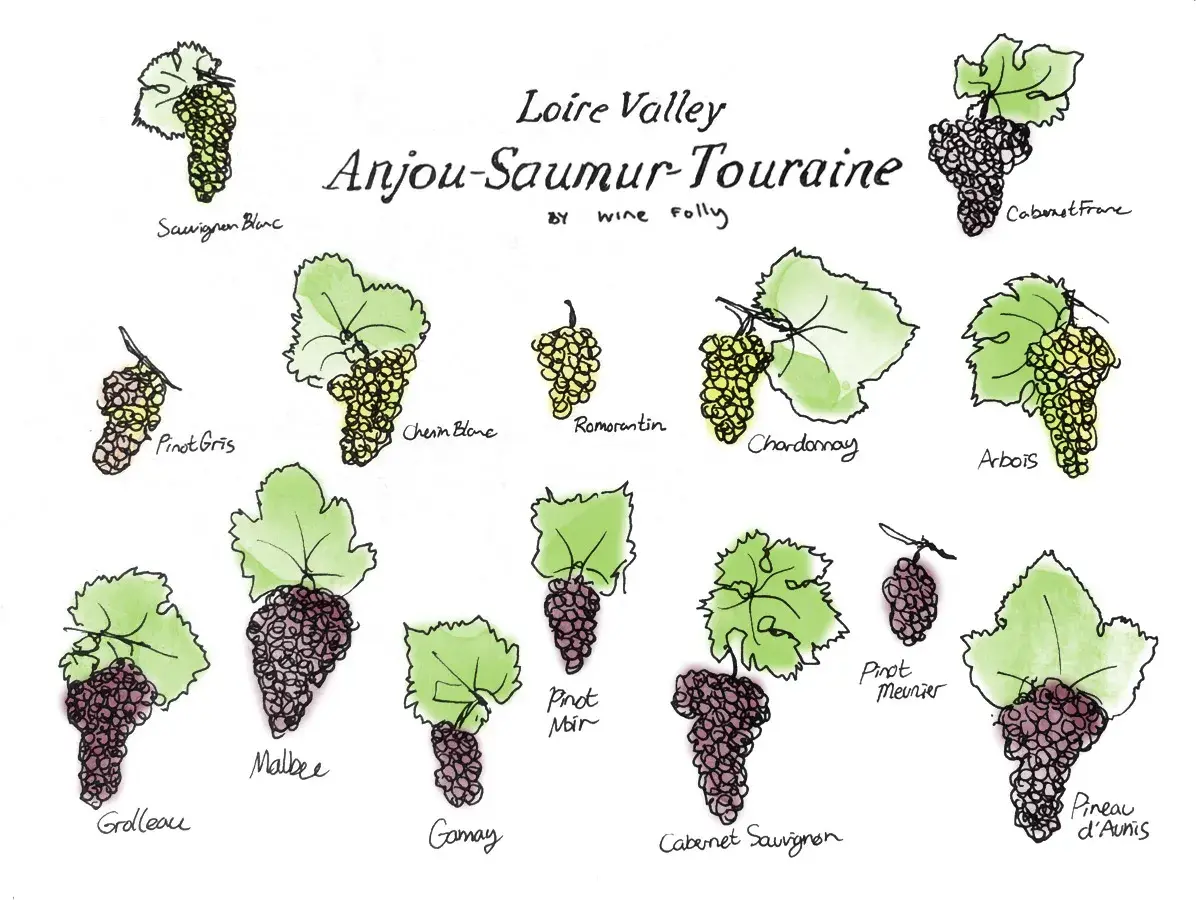
In Anjou-Saumur and Touraine, Chenin Blanc and Cabernet Franc begin to define the landscape. Chenin is the shape-shifter of the region: dry, off-dry, sparkling, and sweet styles all make sense here. Cabernet Franc, meanwhile, gives reds that feel savoury and lifted rather than dense and warm. If you only know the Loire through crisp white wine, this is the part that usually changes your mind.
Once that geography clicks, the grapes make a lot more sense, which is exactly where I would go next.
The grapes that define the region
According to Vins de Loire, more than 100 grape varieties are grown in the region, but a small core does most of the work for drinkers: Cabernet Franc, Chenin Blanc, Melon de Bourgogne, Sauvignon Blanc, Gamay, Chardonnay, and Grolleau. Once you learn those names, Loire labels stop looking like a puzzle and start reading like a map.
| Grape | What it usually makes | Why it matters |
|---|---|---|
| Cabernet Franc | Light to medium-bodied reds, rosé, some blends | Brings red fruit, herbs, pepper, and a finer tannin profile than many other reds |
| Chenin Blanc | Dry, off-dry, sweet, and sparkling whites | The most versatile grape in the valley; it can feel taut, waxy, honeyed, or razor-sharp depending on style |
| Sauvignon Blanc | Dry whites | Gives citrus, cut grass, herbs, and brisk acidity, especially in the central vineyards |
| Melon de Bourgogne | Muscadet | Creates dry, sea-breeze whites with lemon, stone, and saline character |
| Gamay | Light reds and chillable bottles | Adds juicy fruit and easy drinkability without much weight |
| Chardonnay | Sparkling wine and occasional still wine | Less dominant than in Burgundy, but useful in blends and bubbles |
| Grolleau | Rosé and light reds | Soft, fruity, and uncomplicated, often aimed at freshness rather than power |
If I had to reduce the valley to four working ideas, I would say this: Chenin handles range, Sauvignon handles precision, Cabernet Franc handles red-fruit elegance, and Melon de Bourgogne handles the sea. That is the shortcut that makes the rest of the region easier to read.
What the main styles taste like
The practical question is not just which grape is used, but what the wine feels like in the glass. Loire wines cover a wide range, yet they share one useful trait: even the richer styles usually keep enough freshness to stay food-friendly. For serving, I usually keep dry whites around 8-10°C, sparkling wines around 6-8°C, and reds around 14-16°C.
| Style | Typical flavours | Best use |
|---|---|---|
| Muscadet sur lie | Lemon peel, oyster shell, salt, light leesy roundness | Seafood, oysters, grilled fish, anchovies, fried starters |
| Sancerre and Pouilly-Fumé | Citrus, gooseberry, herbs, flint, зел? no, just mineral tension | Goat’s cheese, shellfish, herb salads, cleanly cooked fish |
| Dry Chenin Blanc | Apple, quince, beeswax, chalk, sometimes a faint honey note | Roast chicken, creamy fish, vegetables, hard cheese |
| Cabernet Franc reds | Red currant, raspberry, pepper, leafiness, a graphite edge | Duck, lamb, mushrooms, charcuterie, grilled vegetables |
| Crémant de Loire | Citric brightness, pear, brioche, fine mousse | Aperitif, seafood, light fried dishes, mixed starters |
| Sweet Chenin | Apricot, honey, preserved citrus, orchard fruit | Blue cheese, fruit desserts, spiced dishes, pâté with fruit |
The term sur lie comes up often with Muscadet. It means the wine rests on its fine lees after fermentation, which adds texture and a slightly savoury finish without making the wine heavy. That small detail is one reason the style punches above its price when it is well made.
Once the flavour map is clear, the next useful question is what actually works with food, especially if you are building a menu that leans seafood-forward or Basque-influenced.
Which bottles work best with Basque food
Loire wines are such good partners for Basque cooking because they tend to add lift rather than compete with the food. Basque dishes often balance smoke, olive oil, seafood, peppers, garlic, and cured flavours, so I usually want acidity, clarity, and enough texture to keep up without drowning the plate.
Here is how I would pair the region’s main styles with a practical menu:
- Muscadet with oysters, clams, grilled sardines, anchovies, or a plate of pintxos built around briny bites. Its saline edge makes shellfish taste cleaner and sharper.
- Sauvignon Blanc from Sancerre or Pouilly-Fumé with grilled hake, piperade, herb omelettes, or dishes with a lot of fresh green flavour. The wine’s brightness works well when peppers, herbs, or citrus are doing the talking.
- Dry Chenin Blanc with bacalao, roasted chicken, creamy sauces, chargrilled courgettes, or an Ossau-Iraty-style sheep’s cheese course. If the dish has a little richness, Chenin usually has enough shape to stay interesting.
- Cabernet Franc with txistorra, duck, lamb, mushroom croquettes, or grilled vegetables with a little smoke. I like it most when the food has savoury depth but not too much weight.
- Crémant de Loire as the flexible option for mixed starters, fried snacks, or a table of varied pintxos. Bubbles are often the easiest answer when you are serving several small plates.
If I had to pick one rule, it would be this: match Loire wine to the dominant texture of the dish, not just the main ingredient. A peppery piperade needs different treatment from an oily fish plate, even if both sit under the broad heading of seafood or vegetables.
That pairing logic is what keeps the region so useful in restaurants and at home alike, and it leads naturally into the practical business of choosing a bottle without wasting money.
How to buy well in the UK without overpaying
In UK shops, Loire wines often sit in a sweet spot where the first step up in price gives a real step up in quality. In broad terms, I would expect everyday bottles to start around the low teens, the most reliable value to sit roughly in the £12-20 band, and more serious cuvées to move above that when you want texture, age potential, or a more specific vineyard expression.
When I am choosing a bottle, I look for a few practical clues rather than just the word “Loire” on the label:
- Choose the subregion first. Muscadet, Sancerre, Vouvray, Chinon, and Saumur all tell you far more than a vague regional label.
- Check the style words. In French, sec means dry, demi-sec means off-dry, and moelleux means sweet. Those words matter more than grape variety in some cases.
- Look for “sur lie” on Muscadet. It usually signals a little more breadth and a more complete finish.
- Do not over-chill Chenin. If you serve it too cold, you hide the texture and the fruit turns thin.
- Give young Cabernet Franc a little air. Thirty to 45 minutes in a decanter can soften the edges and bring out the fruit.
- Buy according to dinner, not habit. If you are serving oysters or clean fish, don’t pay extra for weight you will not use.
The most common mistake I see is people treating every Loire white as if it were the same wine in a different bottle. It is not. Some are sharp and maritime, some are stony and smoky, and some are round enough to handle a richer plate. Once you learn to read that difference, the region becomes much easier to shop.
From there, the fastest way to understand the valley is to taste it in a small sequence rather than trying to learn everything at once.
A four-bottle route that shows the region fast
If I were building a compact tasting line-up for someone new to the valley, I would choose four bottles that show contrast rather than repetition. That gives you the full range without needing a cellar or a long shopping list.
- Muscadet Sèvre-et-Maine sur lie for the maritime side of the region. It teaches you what Loire freshness feels like when salt and minerality are the point.
- Sancerre or Pouilly-Fumé for precision. This is the most recognisable expression of Sauvignon Blanc in the valley, and it shows how clean and focused the style can be.
- Dry Vouvray or Montlouis-sur-Loire for Chenin’s texture. This is where the grape stops being just “fresh white wine” and starts showing depth.
- Chinon or Bourgueil Cabernet Franc for red wine with restraint. It proves that Loire reds can be savoury, lifted, and quietly complex without becoming heavy.
If you want a fifth bottle, I would add Crémant de Loire. It is the easiest way to see how well the region handles bubbles, and it is often the bottle that wins over guests who expect Loire to be all sharp whites and little else. Put those wines on the table in that order, and the valley starts to make sense very quickly.
