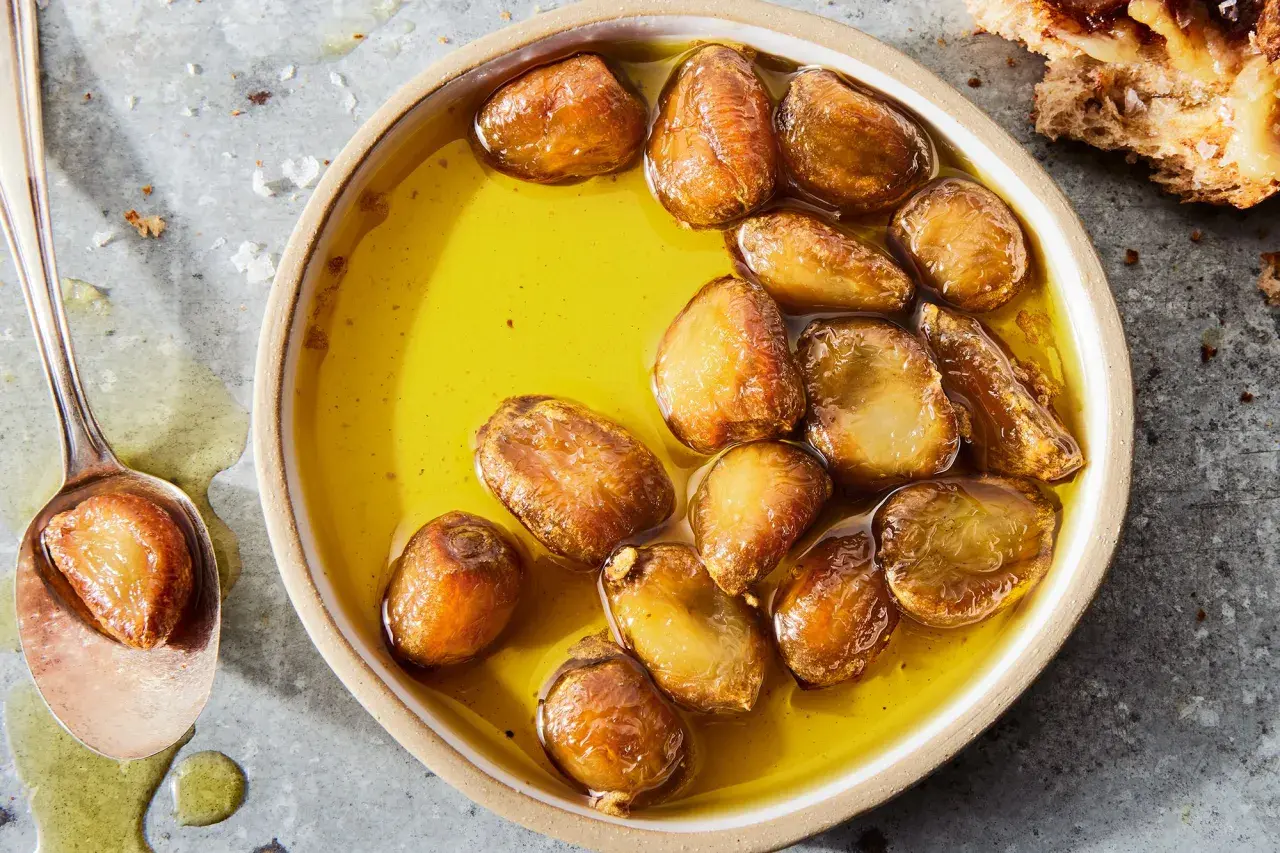
Learning how to make garlic confit is mostly about patience: you slowly cook peeled cloves in oil until they turn soft, sweet, and spreadable, then you chill the jar so it stays safe to use. Done properly, you get a mellow garlic paste and a deeply flavoured oil that can lift everything from toast to fish, beans, and vegetables.
I reach for it when I want more depth than raw garlic can give, but less sharpness than roasted garlic. On a Basque-style table, that makes it easy to work into simple food without overpowering it.
The essentials for a sweet, safe jar of garlic confit
- Use fresh, firm garlic bulbs and enough oil to cover the cloves completely.
- Keep the heat very low; the oil should barely tremble, not fry.
- Cook until the cloves mash easily with a spoon, usually in about 45 to 90 minutes depending on batch size and heat.
- Cool quickly, refrigerate immediately, and use within 7 days unless you freeze it.
- Save the oil as well as the cloves; both are useful in dressings, mash, and sauces.
What garlic confit is and why I reach for it
Garlic confit is simply garlic cooked slowly in oil until the harshness fades and the natural sweetness comes forward. The result is tender enough to spread, mash, or stir into a sauce, and the oil itself becomes a flavouring ingredient rather than a by-product.
That dual use is why I like it so much. One jar can do the work of several ingredients: it softens a vinaigrette, rounds out a pan sauce, and gives vegetables a more relaxed, savoury finish. In a Basque kitchen, where restraint and good produce matter, that kind of quiet intensity is useful. It plays well with grilled peppers, white beans, hake, cod, and simple bread.
The trick is not to treat it like a frying job. Confit depends on gentle heat, not colour, and that difference is what keeps the garlic sweet instead of bitter. Once you understand that, the rest of the method is straightforward.

How I make it step by step
For a small batch, I usually work with 2 to 3 medium garlic bulbs, which gives me enough confit for a few meals without risking waste. A snug saucepan or a small ovenproof dish helps the cloves stay submerged and cook evenly.
- Peel the cloves and trim away any damaged or sprouting pieces. I want firm, glossy cloves rather than soft or dry ones.
- Put the cloves into a small saucepan or ovenproof dish and add enough oil to cover them by about 1 cm.
- If I want extra aroma, I add 1 small bay leaf or 2 thyme sprigs. I keep the flavouring light so the garlic stays central.
- Warm the oil over the lowest possible heat until tiny bubbles start to appear around the cloves. At that point, the oil should look active but calm, not sizzling.
- Cook gently until the cloves are pale gold and a knife slides through them easily, usually around 45 to 75 minutes on the hob. In the oven, I use a low setting and check a little earlier, because every dish behaves differently.
- Lift out the garlic carefully, then transfer the cloves and oil to a clean, heatproof container so they can cool quickly before chilling.
If I use the oven instead of the hob, I keep it low, around 120°C fan or 140°C conventional, and use a covered dish or a loose foil lid so the cloves do not dry out. That version is useful when I want less babysitting, but I still check for softness rather than relying only on the clock. The goal is always the same: tender garlic, not browned garlic.
Once you have the method in hand, the next question is usually which ingredients give the best result, and that comes down to produce quality more than anything else.
Choosing the right garlic, oil, and aromatics
I treat the ingredient list as short on purpose. Garlic confit works because the garlic is good, the oil is good, and nothing distracts from that relationship. If the produce is tired, the finished jar will taste flat no matter how carefully you cook it.
| Ingredient | What I buy | Why it matters |
|---|---|---|
| Garlic | 2 to 3 firm bulbs with tight papery skins and no green shoots | Fresh cloves cook sweeter and more evenly, with less chance of a woody or harsh aftertaste |
| Oil | Extra-virgin olive oil, or a mild olive oil if I want a softer flavour | The oil carries the garlic flavour, so it needs to taste clean and pleasant on its own |
| Herbs | 1 bay leaf, 1 to 2 thyme sprigs, or nothing at all | A little herb gives depth without turning the confit into a stew |
| Salt | A very small pinch, or none | Salt can sharpen the flavour, but too much is unnecessary if the garlic is fresh |
I prefer olive oil because it suits the flavour and makes the finished jar feel Mediterranean rather than neutral. If I want a more delicate result, I choose a milder oil; if I want the oil itself to be a feature, I go for something fruitier. What I avoid is old garlic, because age shows up quickly here. Confited garlic should taste mellow, not tired.
Once the ingredients are right, the only thing that can really spoil the batch is sloppy heat control, which is the next place I pay attention.
How I keep it safe in the fridge
This is the part I do not rush. Garlic in oil creates the kind of low-oxygen environment where storage matters, so I treat the finished confit like a refrigerated condiment, not a pantry preserve. I never leave it sitting at room temperature, and I do not rely on smell alone to judge whether it is still good.
- Cool the confit quickly in a shallow, clean container.
- Refrigerate it immediately once it is no longer hot.
- Keep the cloves covered with oil while stored.
- Use a clean spoon every time you scoop some out.
- Use it within 7 days if you want the cautious, low-stress approach.
- Freeze any extra in a small container if you do not expect to finish it in time.
If I am honest, the safest habit is also the simplest one: make a smaller batch and eat it quickly. That way the jar is always fresh, and I never have to talk myself into keeping it "just a few more days". If a batch has been left out for too long, I throw it away without trying to rescue it.
Good storage gives you confidence to use the confit freely, and that is when it starts earning its place in real cooking.
How I use it in a Basque-leaning kitchen
The reason I keep garlic confit around is not to make one dramatic dish. I use it because it makes ordinary food taste more composed. A spoonful can turn basic produce into something that feels finished, especially when I am leaning into Basque-style simplicity.
- I mash it into warm white beans with a little olive oil and chopped parsley.
- I spread it on toasted bread before topping the slice with anchovy, tomato, or grilled pepper.
- I stir it into a quick aioli for potatoes, prawns, or roast vegetables.
- I fold it into mashed potatoes beside grilled fish or roast chicken.
- I crush a few cloves into a pan sauce for hake, cod, or seabass.
- I spoon the oil over courgettes, peppers, or tomatoes when I want a clean but richer finish.
The cloves themselves are soft enough to disappear into sauces, but they also hold their shape if you want to keep them whole on toast or next to fish. The oil is just as useful, and I often end up using it faster than the garlic because it slips so easily into everyday cooking. Once that jar is in the fridge, the main question becomes how to avoid the mistakes that flatten the flavour.
The mistakes that change the result most
Most disappointing batches come down to heat, vessel size, or storage, not to the recipe itself. I keep an eye on the following points because they change the flavour far more than adding another herb ever will.
| Mistake | What happens | What I do instead |
|---|---|---|
| Heat that is too high | The garlic browns before it softens, and the flavour turns bitter | Keep the oil just below a simmer and use the smallest burner that will hold that temperature |
| A pan that is too wide | The garlic sits in a thin layer of oil and cooks unevenly | Use a snug saucepan or a smaller dish so the cloves stay submerged |
| Not enough oil | Some cloves dry out or colour too fast | Top up the oil so everything stays covered by about 1 cm |
| Old or sprouting garlic | The final jar tastes harsh, flat, or slightly woody | Buy firm bulbs with tight skins and no green centre |
| Leaving it on the counter | The safety risk rises quickly | Cool it fast and refrigerate it as soon as possible |
My own rule is simple: if the cloves are soft but still pale gold, they are done; if they are colouring fast, the heat is too high. I would rather stop a batch a little early than try to save one that has already drifted into bitterness. Once you start judging by texture instead of time alone, the method becomes much more reliable.
Why a small jar earns its place in the fridge
Garlic confit is one of those quiet kitchen tools that pays back the little time it takes to make. It gives you a soft, sweet garlic base, plus an oil that can carry flavour into vegetables, sauces, and bread without any extra fuss. That is why I keep the batches modest and use them quickly.
If I am planning ahead, I make just enough for the week, label the jar, and freeze the rest only when I know I will not use it in time. That approach keeps the flavour bright, the routine simple, and the safety side easy to manage. For me, that is the real appeal: a small amount of effort on one day, then better-tasting meals for several more.
