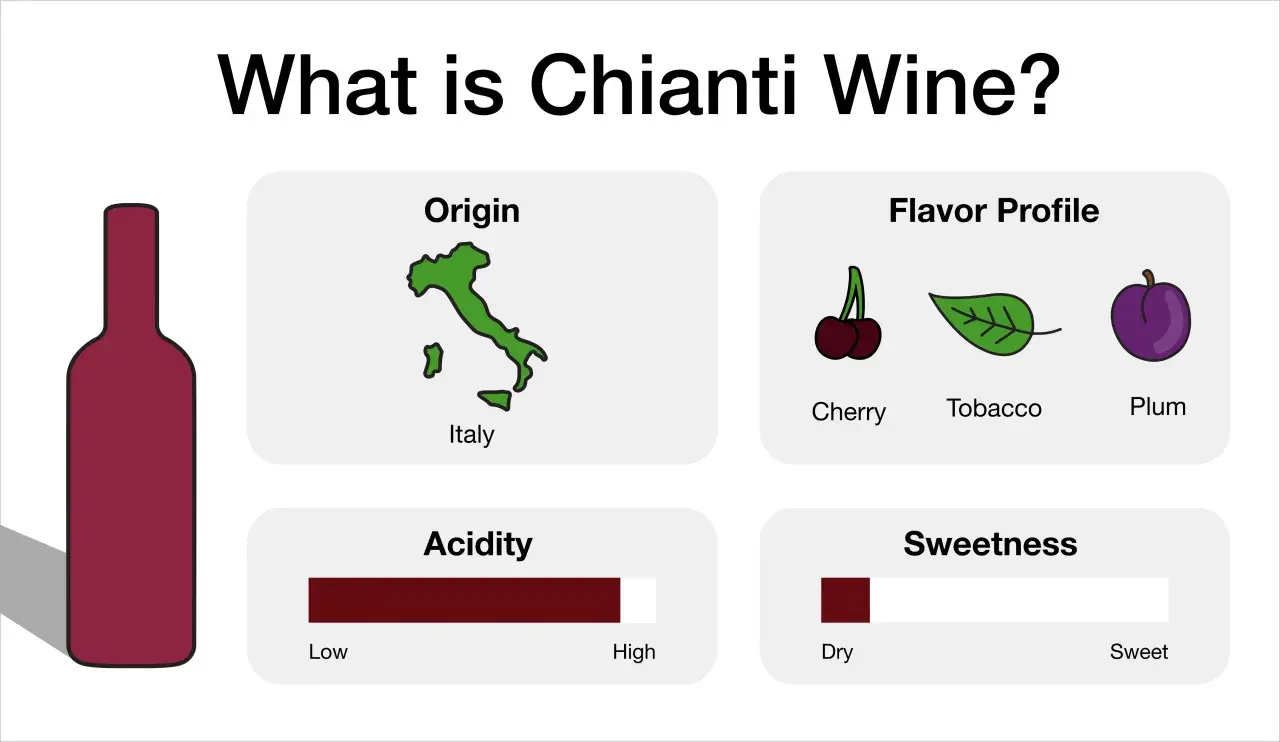
Chianti is one of those red wines that reveals itself quickly: bright cherry, a savoury edge, firm but not heavy tannins, and enough acidity to make food taste better. The chianti wine taste is less about sweetness and more about tension, freshness, and a slightly rustic, honest finish. In this guide I break down what that means in practice, how Chianti changes by style and age, and what to serve with it so the wine feels balanced rather than sharp.
Key things to know before you pour a glass
- Chianti is usually dry, medium-light to medium-bodied, and built around lively acidity.
- Expect tart cherry, red plum, dried herbs, violet, earth, and sometimes leather or smoke.
- Better bottlings add spice, depth, and a longer finish instead of just more weight.
- Serve it slightly cool, not warm, or the alcohol can overshadow the fruit.
- It is at its best with tomato sauces, grilled meat, mushrooms, beans, and aged cheese.
What Chianti usually tastes like in the glass
When I taste Chianti, I think of a red wine that starts with red fruit and ends with savoury detail. The fruit is rarely plush; it is more often tart cherry, sour cherry, red plum, or red currant, with a line of acidity that keeps the wine moving. That acidity is the reason Chianti feels so food-friendly: it acts like a palate cleanser instead of coating your mouth.
Under the fruit, you usually find a dry, herb-led profile. Dried oregano, thyme, tomato leaf, violets, earth, and a touch of leather are all common reference points, especially in better-made wines. Tannin matters too: tannin is the drying grip on your gums, and in Chianti it can feel fine-grained and firm rather than soft and velvety.
| Palate element | What it often feels like | Why it matters |
|---|---|---|
| Fruit | Tart cherry, red plum, red currant | Keeps the wine lively rather than heavy |
| Acidity | Bright, mouthwatering, slightly sharp | Helps the wine cut through rich food |
| Tannin | Dry, grippy, sometimes rustic | Gives structure and length |
| Savoury notes | Herbs, earth, leather, smoke | Makes the wine taste more serious and complex |
| Oak, when used | Vanilla, spice, toast, sweet cedar | Adds polish, but should not drown the fruit |
The simplest way to read Chianti is this: if it feels bright, savoury, and a little angular, it is probably showing its classic shape well. Once that shape is clear, the next question is why two bottles can taste so different.
Why Chianti tastes different from bottle to bottle
The base grape, Sangiovese, does a lot of the work. It naturally brings acidity, red fruit, and a savoury, sometimes slightly spicy edge, but the final style changes with the vineyard, the blend, the age of the wine, and how much oak the winemaker uses. That is why one Chianti can feel almost playful and another can feel serious enough for a long dinner.
The Consorzio Vino Chianti notes that the appellation covers a wide range of styles, and that is exactly what shows up in the glass. Higher-altitude sites often keep more freshness; warmer zones can bring riper fruit; oak ageing can add spice and texture; and bottle age usually softens the tannin while shifting the fruit toward dried cherry, orange peel, leather, and tea.
| Style | Typical taste | Best use |
|---|---|---|
| Chianti | Fresh cherry, herbs, medium grip | Everyday meals, pizza, pasta, simple grilled dishes |
| Chianti Classico | Deeper cherry, violet, earth, firmer structure | Roast meats, mushroom dishes, more detailed food |
| Chianti Riserva | Richer fruit, spice, more integrated oak, longer finish | Slow-cooked meat, aged cheese, more serious dinners |
If you want the label to help you, look for the Black Rooster seal on Chianti Classico. It usually points you toward more structure and a little more definition, which is useful if you prefer wines that feel less easygoing and more layered. That difference also explains why some drinkers love Chianti immediately while others need the right food to unlock it.
How to tell whether it suits your palate
Chianti is a good match for anyone who likes red wines with freshness and savoury lift rather than sweetness or plush fruit. If you enjoy Barbera, Rioja Crianza, or some Pinot Noir styles, you are already close to the right territory. If your usual preference is soft, low-acid reds with lots of vanilla, Chianti may feel lean at first.
Here is the comparison I find most useful when I talk someone through their first bottle:
| If you usually enjoy... | Chianti will feel... | Why |
|---|---|---|
| Pinot Noir | More tannic and more savoury | Chianti has more grip and a firmer spine |
| Barbera | Similar in brightness, but drier and earthier | Both have acid, but Chianti leans more herbal |
| Rioja Crianza | Less oaky, more cherry-led | Chianti usually keeps oak in the background |
| Merlot | Less plush and less rounded | Chianti trades softness for tension |
The most common mistake is expecting Chianti to taste full, sweet, and immediately generous. It usually does not. The other mistake is serving it too warm, which can make the alcohol stand out and push the fruit backward. If you want the wine to feel balanced, the serving temperature matters more than people think.
How to serve Chianti so the flavour opens up
I keep Chianti slightly cooler than a typical “room temperature” red. Around 15-18°C works well for most bottles, and the leaner styles often show better closer to 15-16°C. At that range the acidity feels fresher, the fruit stays clearer, and the alcohol is less likely to dominate the finish.
Decanting depends on the bottle. A young everyday Chianti often benefits from 20-30 minutes of air, while a more structured Chianti Classico Riserva can take 45-60 minutes before it starts to relax. Wine Folly’s handling guidance is broadly in line with that, and in practice I find a short decant or even a generous pour into a larger glass makes the wine easier to read.
- Use a medium or universal red-wine glass, not a tiny tulip.
- Open the bottle 10-15 minutes before drinking if you do not decant.
- If the wine tastes hard, give it air before you decide it is too sharp.
- If it tastes flat or boozy, it is probably too warm.
Once the wine is in the right range, the food pairing side becomes much easier, and that is where Chianti really earns its reputation.
What I would pair with it on a Basque table
Chianti makes the most sense with dishes that have acidity, salt, char, or slow-cooked depth. On a Basque table, I would put it next to grilled lamb chops, txuleta, mushroom omelettes, roasted peppers, bean stews, and aged Idiazabal. Those dishes echo what the wine already does well: they give it enough savoury weight to meet the tannin, but not so much sweetness or creaminess that the wine feels awkward.Tomato-based sauces are a natural fit because Chianti’s acidity matches them instead of fighting them. The same goes for olive-oil-heavy vegetables, chargrilled meats, and salty cured foods. What does not work as well is a dish that is very sweet, very spicy, or very creamy without enough salt and acidity to hold it together; in those cases the wine can start to taste thin or sour.
If I had to choose one simple rule, it would be this: the closer the dish feels to grilled, earthy, or tomato-rich cooking, the better Chianti usually behaves. That leads to one last practical question, which bottle style is worth buying when you want this flavour profile on purpose?
Which bottle style gives you the Chianti taste you want
If you want the clearest version of this wine’s character, I would usually start with Chianti Classico from a producer that keeps the oak restrained. You get more shape, more savoury detail, and a better sense of the grape itself. If you want something a little easier and fresher for weeknight food, a basic Chianti can be perfectly good value, especially with pasta, pizza, or grilled vegetables.
For richer dinners, look one step up. Riserva often brings more concentration and a longer finish, which matters when the food has more weight. If you want the most polished end of the spectrum, Gran Selezione can be impressive, but it is not automatically the best choice for every table. My rule is simple: buy for the meal you are setting, not just for the label.
That is the practical version of Chianti’s appeal: bright red fruit, high acidity, savoury edges, and enough structure to meet real food. If you keep the bottle slightly cool, give it a little air, and put it beside grilled meat, tomato, mushrooms, or aged cheese, you get the version of Chianti that most people remember for the right reason. If I am choosing blind, I start with Chianti Classico and move up or down from there, because that is the fastest way to find the balance you actually want.
