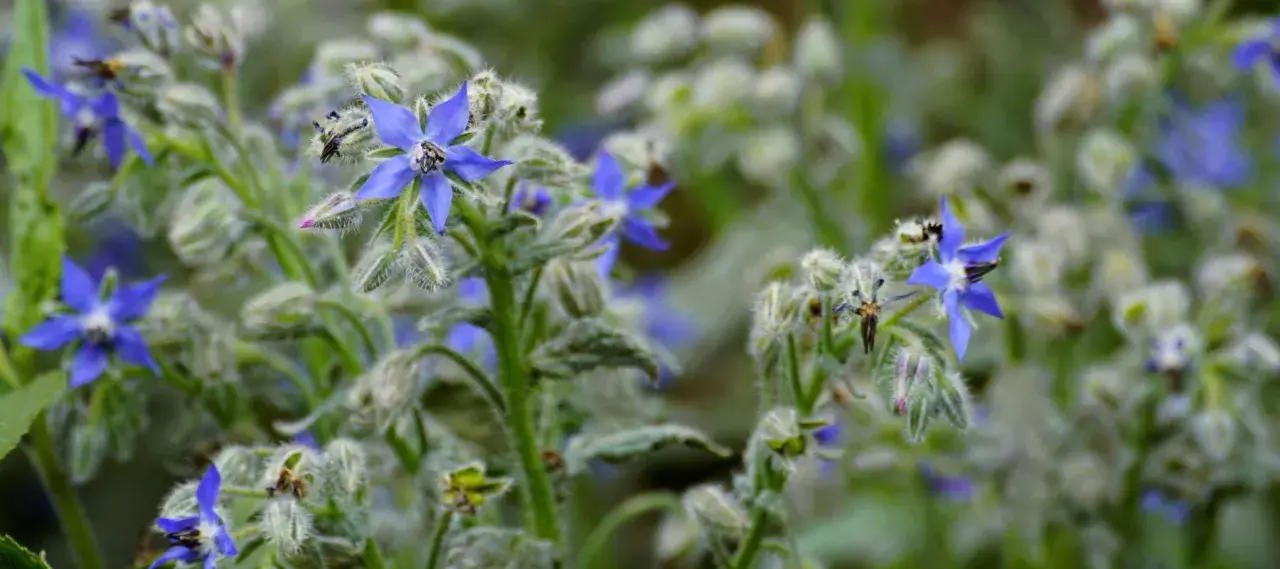
Borage is one of those ingredients that looks ornamental until you start cooking with it. The real borage uses range from edible flowers and leaves to garden support and seed oil, but each one has different rules. I would treat it as a kitchen herb first, a pollinator-friendly plant second, and a supplement source only with caution.
The quickest way to think about borage
- Young leaves bring a cool, cucumber-like note to salads, eggs, soups, and potato dishes.
- The blue flowers work best as a garnish for drinks, desserts, and summer plates.
- In northern Spanish cooking, borage can be a proper vegetable, not just decoration.
- It is easy to grow in the UK, self-seeds readily, and helps bring pollinators into a kitchen garden.
- Borage seed oil is a separate product from the fresh herb, and safety standards matter.
- Borage-leaf infusions are not something I would recommend.
The parts of borage that matter most
When people talk about borage, they often blur together the leaves, flowers, stems, and seed oil. I find it more useful to separate them, because each part has a different role in the kitchen or the garden.
| Part | Best use | What I watch for |
|---|---|---|
| Young leaves | Lightly cooked greens, omelettes, soups, and potato dishes | Use them young; older leaves get coarse and less pleasant |
| Flowers | Salads, drinks, desserts, and ice cubes | Pick them close to serving so they stay fresh and tidy |
| Stems | Peeled and cooked as a vegetable | Tough stems need trimming and peeling |
| Seed oil | Supplement or cosmetic ingredient | Buy PA-free products only |
| Whole plant in the garden | Pollinator support and easy self-seeding | Leave enough room; it can sprawl |
That split matters because the fresh herb and the oil are not interchangeable. I would never judge the whole plant by a bottle of oil, and I would not expect a garnish flower to do the work of a supplement.

How I use it in cooking
Borage is a light-touch ingredient. It does not want to be treated like rosemary or sage, where the whole point is a strong, persistent flavour. I use it when I want something fresher, greener, and a little cooling on the palate.
- In salads - Young leaves can sit alongside lettuce, herbs, cucumbers, radishes, and soft cheeses. The flowers add colour without changing the dish much.
- With eggs - I like it in omelettes, frittatas, and scrambled eggs because the flavour stays gentle and the texture disappears quickly.
- With potatoes - Borage pairs naturally with boiled or sautéed potatoes, especially when the dish is finished with olive oil and garlic.
- With fish - On a Basque-style table, I would happily put it next to hake, cod, or other white fish. The herb is subtle enough to support the fish rather than fight it.
- In drinks and desserts - The flowers are at their best as a garnish for summer drinks, fruit salads, sorbets, and simple cakes.
That last point is why the plant works so well on a restaurant table. The flower is decorative, yes, but the leaf can still carry a dish if you keep the treatment simple. In northern Spanish cooking, borage is sometimes handled as a real vegetable, which is a useful reminder that it is more than a cocktail garnish. If I want the flavour to stay clear, I keep the seasoning restrained: olive oil, salt, a little lemon, and just enough garlic to give the dish shape.
Why gardeners keep planting it
The Royal Horticultural Society describes borage as an easy annual herb for sunny spots, and that matches my experience. It is not fussy, it self-seeds readily, and it brings a lot of life into a bed for very little effort.
For UK growing, the basics are simple:
- Plant it in full sun if you can, though light shade is acceptable.
- Avoid waterlogged soil; borage likes moisture, not standing water.
- Sow seed or plant out in spring, usually April or May.
- Give mature plants about 50 cm between them.
- Use a container at least 30 cm wide if you are growing it in a pot.
- Do not overfeed it; a poor or sandy soil may need a spring boost, but most garden soils are enough.
I like borage for kitchen gardens because it does two jobs at once. It gives me edible leaves and flowers, and it also helps bring pollinating insects into the space. That matters more than it sounds, because a healthy crop of flowers often means a healthier garden around it.
What the health claims really mean
This is where I become careful. Borage seed oil has a genuine reputation in herbal medicine, mainly because it contains gamma-linolenic acid, or GLA, but the evidence for many of its advertised benefits is mixed. Some studies suggest it may help certain inflammatory conditions, but it is not a miracle ingredient, and I would not sell it to a reader that way.
The bigger issue is safety. The Food Standards Agency says borage-leaf infusions can contain very high levels of pyrrolizidine alkaloids, so I would avoid borage tea entirely. If you buy seed oil, look for a product that is certified PA-free, because those compounds can affect the liver. I would also avoid internal use during pregnancy or breastfeeding, and I would not use it casually if someone has liver disease or is taking medication that already stresses the liver.
My practical rule is simple: fresh borage is food, seed oil is a supplement, and leaf tea is a bad idea. Once you keep those categories separate, the plant becomes much easier to use well.
How to buy, store, and grow it in the UK
If I am buying borage fresh, I look for tender, shiny green leaves and flowers that still look crisp, not tired. Rough, yellowing, or limp leaves are a sign to pass. The plant is quite perishable, so I keep it chilled in a perforated bag and wash it only when I am ready to cook.
For a home garden, I would work with the plant’s natural habits instead of against them. It usually reaches about 50 to 70 cm tall, and it is perfectly happy being allowed to self-seed in a corner of the bed. If I want tidiness, I deadhead it after flowering. If I want a steady supply, I let a few flowers set seed and accept that the plant will return on its own.
Harvesting is best done with restraint. I pick flowers just before use, and I use the youngest leaves first. If the stems have become fibrous, I treat them like a vegetable and cook them properly rather than trying to force them into a raw salad. That simple adjustment saves a lot of disappointment.
The rule I follow when borage reaches my kitchen
- Use the leaves when they are young and fresh, not tired or tough.
- Use the flowers for lift, colour, and a light cucumber note.
- Treat the seed oil as a separate product with its own safety checks.
- Avoid borage-leaf infusions altogether.
Used that way, borage earns its place without pretending to be more powerful than it is: a useful, seasonal plant with a clear role in the garden and a surprisingly flexible role on the plate.
